Tuesday, June 24, 2014

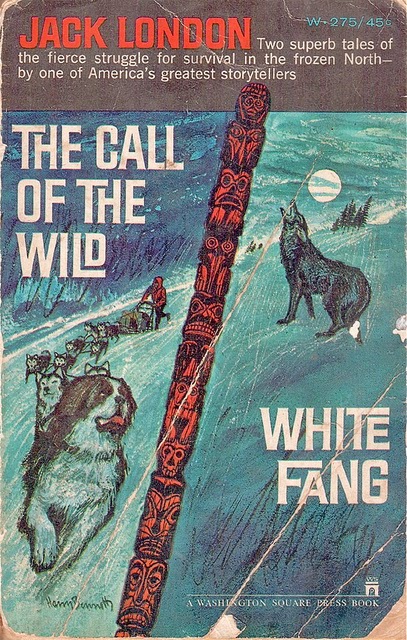
The Call of the Wild & White Fang: The companion novels of Jack London

Photo credit: m.gross196 on Flickr
"Life itself was meat. Life lived on Life. There were the eaters and the eaten. The law was: EAT OR BE EATEN. He did not formulate the law in clear, set terms and moralize about it. He did not even think the law; he merely lived the law without thinking about it at all."
-White Fang

Thomas Nagel, an American philosopher I know very little about, wrote an essay called "What its like to be a bat" in 1974. The main point is that one can never truly know what it is like to be someone or something else. Should some power be able to transport the essence of yourself into the body of a bat, perhaps even with some of the instincts of a bat, so that you could then return and report back on the experience, you'll never have actually had the experience of being a bat. Because, by definition, being a bat is not knowing and understanding what it is to be anything else. You would only have accomplished knowing what it is like to be you in the body of a bat. And so truly experiencing what life is like in another's skin is impossible. Even so, Jack London does a helluva job describing the life of a dog in White Fang and The Call of the Wild

I'm really beginning to love Jack London. After first reading The Call of the Wild and now White Fang I am really drawn into his writing. Like Hemingway, London has a relatively bleak style, but the similarity is due more to the shared subject matter than the lack of narrative more characteristic of the former. Both writers spend a lot of time describing very basic, physical processes that suggest a natural state of being. In both of these books by London, the primary point of view is that of a wolf/dog or dog/wolf, respectively White Fang and Buck, and so while human events, actions, and words are described, the only understanding that is spelled out is that which the dog possesses. We must infer anything else that is happening - some is obvious and some unimportant and unmentioned.

They are essentially the same story told in reverse. Which is forward and which is reverse depends either on which you read first or which you prefer. One follows a dog with a bit of wolf in him and his journey from the cushy Santa Clara valley to the hard life as a sled dog in the Alaska wilderness to, finally, complete freedom as a wholly wild animal. The other follows a wolf with a bit of dog in him in the Alaska wild that learns to trust man, fear man, work for man, and eventually winds up in a cushy situation in the Santa Clara valley of California with man as his welcome master - the Lovemaster (London could never have known how ridiculous that name would sound to today's reader - you almost expect some funky music to start after you read it the first time - the luuuvmaster). Both stories completely justify every step in the life of a dog, from loving loyalty to savage brutality.

The beauty of this reversal is only complete after reading both books - which for all intents and purposes seem to me - a first time London reader - as perfect companion novels. Both have periods of intense suffering due to poor treatment; interaction with and learning to understand humans; poignant descriptions of the reality of the call to live in complete wild freedom; and an emotional climax that involves true xenophilic love between man and beast. This last bit is best portrayed in The Call of the Wild between Buck and Thornton, a member of a small group of back-country wildmen that knows enough to respect a remarkable animal when he sees him. Those passages are so moving and well-written, they are the only bit of prose or poetry that has ever made me consider actually getting a dog. Tears are welling up for you already, I'm sure.

Because each process of role reversal in this pair of books is so carefully crafted to convince the reader that the result is within the realm of natural balance, London is telling us that mortality is a state in which conflicting forces must and can be adhered to. Whether it be the freedom of the call, or the love of the domestic relationship, either can bring a state of peace. As someone that finds it easy to be convinced that either one of these ideals is superior, I find it comforting to come to this realization through London's writing - although that may just be an excuse I use to keep myself from feeling guilty about something.

The author may not have been attempting to make universal statements of the existence of man and the mortal condition. But to bring up Hemingway again, that great author said something regarding symbolism in writing that I might apply to London's writing here "No good book has ever been written that has in it symbols arrived at beforehand and stuck in. ... But if I made them good and true enough they would mean many things." So it is with these two great dogs. London, a man with an adventurous life of his own that took place in some of the same settings these books take us, used what he knew to tell true stories about life. Anything more we read into it may be just a way for English majors to get top grades or make tenure.

However, if we do question his actual intent towards application in our lives, we only need to review one of the many passages that point directly back to ourselves. The following is a great one of these:
"There is an ecstasy that marks the summit of life, and beyond which life cannot rise. And such is the paradox of living, this ecstasy comes when one is most alive, and it comes as a complete forgetfulness that one is alive. This ecstasy, this forgetfulness of living, comes to the artist, caught up and out of himself in a sheet of flame; it comes to the soldier, war-mad in a stricken field and refusing quarter; and it came to Buck, leading the pack, sounding the old wolf-cry, straining after the food that was alive and that fled swiftly before him through the moonlight." -The Call of the Wild
Once we forget we're the bat - then we can know what it is like. But then it is forgotten the moment we try to think about it and pin our finger on it. My final takeaway? I'm only really alive when I'm eating - so pass the meat.

Wednesday, June 11, 2014

Wayne's World

Poster credited to worth1000.com
The elements that make a good comedy are so elusive. All of the right tools can seem to be there - great cast, writing, & directing - but more often than not it comes off flat. Of those that are enjoyable, many only have topical humor that makes sense when framed historically. Few seem to stand the test of time, and even then it is hard to divide that from the individual experience. Sense of humor is so relative. Because of this I think any review of a comedy should be taken with a grain of salt. The same holds for my review of Wayne's World. I realized I'd never seen this movie beyond youtube videos of the famous "Bohemian Rhapsody" scene. Netflix just added it to their Watch Instantly catalog and so I queued it up and gave it a go. It was a delightfully weightless bit of fun.

The main reason why I wanted to record my thoughts on it is because of the way it dealt with the story. Normally a Hollywood comedy is so burdened by over-emphasized plot points. It becomes heavy and you just sit there counting the seconds waiting for the inevitable to happen. For that reason I find that the best pure-comedies forego the story line and just let you lay out and soak in the atmosphere and personality of the movie. What makes a good comedy is that it is full of characters that you want to spend time with in a world you want to spend time in.

With Wayne's World I was a little worried at the start as Wayne & Garth (played by Mike Myers and Dana Carvey) were getting set up to fail as they enter what is obviously a raw deal in going corporate with their public-access TV show - the main struggle of the movie - but it never spent enough time on that to drag the movie down. It thankfully glossed over all the main plot setup, coasted through the second-act escalation, and jetted right on to a joyful finale. This left more time for all the real fun like constantly breaking the fourth wall ("Hey, only Garth and I can talk to the camera!"), making fun of contemporary Hollywood (writing out "Gratuitous Sex Scene" instead of showing it), and plenty of pointlessly fun exclamations (Party on! Excellent! Schwing!). I was in a constant state of feeling pleasantly surprised as I enjoyed the little quirks and random jokes that often don't get into movies today because they are trying to follow a formula (a formula established in part by the success of the 90's SNL generation movies like this one).

While it's definitely teenage and immature, it is relatively low on the low-brow humor that seems necessary in the current comedic landscape. Some of the Judd Apatow films are thoughtfully funny, but that's in spite of the intense language and bathroom humor rather than because of it (I'm sure there are plenty who disagree - but good comedy and drama shouldn't use the crutch of ridiculously obscene language). I mean don't get me wrong, every part of the human anatomy gets its fair shake (har har). But While Wayne's World certainly wouldn't be labeled as clean, it doesn't rely solely on dirty jokes (it's PG-13 - check out a Parent's Guide for more info).

Instead, what may turn some of the younger viewers away, if seeing this for the first time, is that many of its references are a generation or two old. The Laverne & Shirley sequence or the commercial spoofs just don't make sense if you haven't seen the source material - although with those carefree, goofy smiles on Wayne's and Garth's faces, you'll laugh anyway. But I think the fact that Wayne's World helped establish this type of comedy might just cross generational boundaries.

The one thing I would've wished for more of was the actual public access TV show. I know all the old SNL skits are online whenever you like, and the pull for many of these transfers to the big screen is the ability to find who these people are, but the real charm of this movie is just watching Wayne and Garth be themselves, little to no plot line required. Rather than seeing what happens to them, Wayne's World is just an excuse to hang out with them a little longer.

Friday, February 21, 2014

Book: American Gods (Tenth Anniversary Edition) - Neil Gaiman

American Gods is like a more adult-oriented version of Percy Jackson: a human gets pulled into the comings and goings of the world of the Gods in America. The main mechanism behind how the Gods got here is that they were all brought here by people emigrating from different parts of the old world, Africa, and even the land-bridge from Asia. The Gods, the versions of them that make it to and then stay in America, and how they are supported by a dwindling mass of belief in modern times, is what the book slowly shows you throughout its length.

The frequent interludes telling the stories of the immigrants are often the best part of the book, which is written in a deliberate yet intriguing style. I listened to the expanded 10th Anniversary version of the book, which included a full cast. The author himself, Mr. Neil Gaiman, speaks the introduction, the afterword, and many of the immigrant stories. He is the best audiobook reader I've encountered (go listen to his "The Graveyard Book", even if you've already read it). Of course, his British accent is great (I wish I knew how to differentiate between types of British accents - anyone know of a guide somehere??) and he's just so calm and purposeful as he reads.

This book is all about Gaiman's interpretation of America as a conglomeration of belief. The best representation of this comes in a speech by one of the book's best character's, Samantha Black Crow. Knows by fans of the book as the "I believe" speech, it reflects a culture that can paradoxically believe in many hypocritical maxims with all sincerity. Read that speech here.

I haven't even mentioned the main character yet. His name is Shadow and he is an along-for-the-ride kind of guy, slowly learning where his place is and what his existence is worth and what it means. Perhaps he could be a representation of your average American? It depends on what you believe.

Warning: Strong language throughout. Also a few graphic sex scenes - easy to skip over without losing much.