Showing posts with label Music. Show all posts

Thursday, October 29, 2020

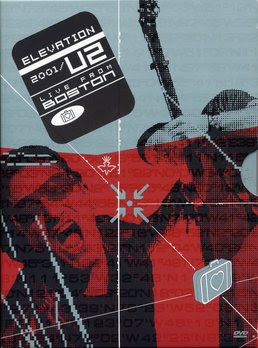
U2: Elevation 2001 - Live From Boston

Cover of U2 live in Boston
You probably remember your first-ever live concert. You felt the thrill of being a part of the crowd and the excitement of seeing the artist take the stage. Perhaps you found a greater appreciation for a certain member of the band and realized that in a live setting, songs you’d heard only in their recorded versions came alive in a new way. You may remember feeling the high, jumping up and down with excitement, and then just basking in the afterglow as the last song ended and you came back down to reality.

Hopefully you had an experience like that the first time you saw U2. That’s the way it was for me. It was when I watched U2. Live in Boston. The Elevation Tour DVD.

Ok, ok, hear me out. Let me give you some context. I grew up mostly in a little town in northeastern Montana during the early days of the internet era. I happened upon U2 through a series of random events that could only be orchestrated by Fate, and obtained The Joshua Tree CD when I was 11. I started to collect the band’s albums whenever and however I could. Again, it was long before iPods. Also, my only job was mowing my grandpa’s lawn.

I was 15 when All That You Can’t Leave Behind came out and it was the first album release I experienced in real time. I remember waiting SO LONG for music videos to load on U2.com over our dial-up modem. All I really knew about the band at this point was picked up by poring over liner notes and listening to their music incessantly on my Discman. Now they were the big thing of the moment, “Beautiful Day” was a hit, and they were all over TV. They were even going on tour! I was several days of driving away from anywhere they were headed and I didn’t even consider attending a show a possibility. Not happening.

Fast forward to early 2002. Always a music nerd, I was on a band trip in Billings, MT, and so we stopped at a mall for a few hours of shopping. This was like a visit to a pop culture oasis, and I was thirsty. I hightailed it to Sam Goody to look for music. As always, I went straight to the “U” section, and that’s when I saw it: the special edition DVD box set for The Elevation Tour: Live In Boston. Like a movie of U2? Where they’re recorded playing live? A whole concert? I paid the $32.99 without a thought – not a little sum to me in those days.

When I got home a day or two later, at the first chance I got I rushed down to our basement and put in the disc with the concert. I was tingling with anticipation and all alone with a front row ticket. From the first moments I was in a trance. I remember the slow-motion walk as the band enters the arena to the intro of “Elevation” with the house lights up. They start playing until, BOOM, the lights go out and they hit it hard. “Elevation” wasn’t my favorite song on ATYCLB but at this point I was all alone, in my basement, lights off, watching this amazing moment and FREAKING OUT.

One thing I learned while watching the show was that The Edge is the engine that keeps this band running. His guitar solos in “Until The End Of The World” and “Bullet The Blue Sky.” His angry guitar-slamming at the end of “Gone.” His beautiful smooth crooning on “In A Little While” – be still my heart. I could never have fully realized how much work The Edge does for the band until I saw him live. He became my hero.

There were many classic U2 moments that were completely new to me and I experienced for the first time: the bullfight between Bono & The Edge in “UTEOTW”; Larry’s snare drumming in “Sunday Bloody Sunday”; the crowd singing the end of “40”; the unforgettable climax of “Streets”; Bono singing intimately to the entire arena through one girl brought up on stage in “With or Without You”; and on and on.
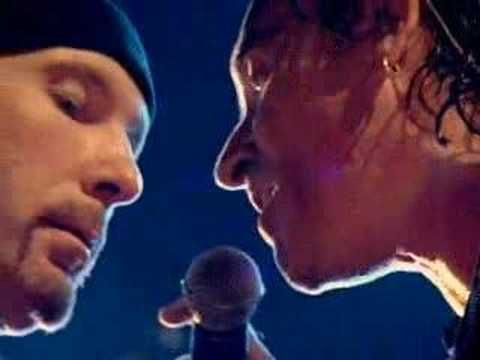
Bono & The Edge close-up singing

I had underestimated or previously failed to notice many of the songs they played, and seeing them performed in this context brought fresh perspective. “UTEOTW,” “Gone,” “I Will Follow,” “Stay,” and “The Fly” were all in that category. I went back to the records and heard these songs with new ears. And the combination of “Bad” in to “Where the Streets Have No Name” at the show’s zenith is almost indescribable. These were already some of my favorite U2 songs, but before this I hadn’t realized their full potential: two of the band’s most soaring anthems coming together in a blissful explosion. I know some say “City of Blinding Lights” is the new “Streets,” but there is nothing that compares for me.

I also knew ATYCLB really well, so “Beautiful Day,” “Kite,” and “New York” felt exciting. But it was “Stuck in a Moment You Can’t Get Out Of” and “In A Little While” that had me, at first, up out of my chair with excitement, and, at their conclusion, each leaving me in a puddle on the floor. And “Walk On” was a perfect closer. I was almost in tears as Bono sang out his declarations of gratitude. As the last notes approached and the credits started to roll, I just sat there dumbfounded, paralyzed, basking in the experience.

I know I wasn’t at a live concert, but there are few moments in my U2 fandom as visceral and exciting as watching this amazing concert film. It transformed my understanding of the band. As a student of the visual medium, the story told through the editing was energetic and put me in all the right places of the arena at all the right times. In addition to the music, I also loved hearing Bono tell stories and seeing how the four band members interacted with each other in a hundred small moments. I felt like I really got to know them and was blown away by how they connected with the audience.

Since then, I have seen the band six times live. The first time was the 360° tour in Chicago. Even though I was way up in the cheap seats, it was a thrill with many impactful moments. Still, I can remember Live in Boston more than I remember moments from that tour. The next time I saw them on the GA floor at Innocence and Experience, just a few feet from the front bar, was when I finally had the truly rapturous live, in-person experience. The Joshua Tree 2017 and Experience and Innocence tours both provided some amazing memories as well. But I will always remember fondly the Sunday afternoon that this nerdy, small-town teenager really got a taste of seeing U2 live. I’m excited for all of those who will get to see U2 live in some really amazing places starting next month on the Joshua Tree tour 2019.


Monday, September 30, 2013

Music: Blur 21

So you know that song you often hear at sporting events or on commercials with the vocals that scream "Woo hoo!"? It starts with some solo drums, a simple electric guitar riff, and then explodes with distortion, bass, and, of course, the famous Woo-Hoo's. Its a song we've all heard. It's called "Song 2". I'd like to introduce you to the group behind the song: Blur.

Hopefully you already know about Blur, but if not they are a pivotal British pop/alternative group whose most commercially-successful and popular era was the mid 90's. "Song 2" was just their accidental one-time US hit. They started in the very late 80's, became wildly famous in England in the 90's, and today, after a hiatus and reunion, play the occasional festival. Their frontman, Damon Albarn, is a prolific musician with a host of crossover collaborations under his belt, the most popular being Gorillaz, of "Clint Eastwood" fame. Blur's career started as a basic, white-collar pop-rock group with songs that parodied the banality of the routine, emotionless daily life. By the time their album Parklife (1994) hit they were the biggest thing in Britain (so I'm told). Quickly afterward they retreated inwardly as they struggled to deal with the unexpected fame they'd encountered. They didn't really sign-on to the "sex, drugs and rock n' roll thing." By 1997 they released the very raw Blur, from which sprung "Song 2." That album was a turning point artistically, and the music just got better with 13 (1999). Think Tank (2003) was their last full-length album and is their most polished and infinitely-listenable album. The recording of Think Tank was difficult for the band. Originally a foursome, they were a threesome by the time it was released. Since then they've gotten back to their full roster, headlined many big music festivals, and even released a song or two.

Blur is a great example of what I feel is a principle of great musicians that works against the current cycle of the popular music industry: musicians make better music as they mature. I might be wrong about that. I'd imagine its easier to market something that already has a following. But critically, a great artist often has a hard time living down their first great album. The crescendo career is a trademark of great artists that are dedicated to their craft - continually improving upon the serendipitous combination of raw enthusiasm and talent that led to their early successes. The pop culture industry focuses on youth and the excitement of a beautiful new face that puts a few young artists at the top of the charts. Even among more level-headed critics, many artists can never overcome their early successes despite the fact that their experience and perspective later in life affords them the opportunity to make better music. For notable filmmakers, actors, writers, and musicians, the key work that brings that initial success can never be replicated. Credit is rarely given for innovation as an artist's career progresses. After a first groundbreaking or critically-successful release, many artists become defined by those notable, early offerings. It is true that if it weren't for their earlier successes, many established artists' works would not receive as much attention - but that doesn't mean that we need to wrap those works as a noose around their neck. For Blur, the later stuff is the best.

Blur is (clockwise from top left) Graham Coxon, Alex James, Dave Rowntree, and Damon Albarn

Blur is not a perfect band with a perfect catalogue (Brit spelling). There are many flaws that, when looked at individually, can make them look rather amateur. The first few albums, honestly, are nothing special. But the same holds true for many great bands (i.e. Radiohead's Pablo Honey). Let's face it - pop, rock, and alternative music is usually very basic as far as the general instrumentation and format goes. They lack the structure and intelligent design of more serious genres like classical and jazz because they are often based more on intuition and superficial differences, at best, and market share, at worst. But we love it because it is easy to connect with the visceral experience of our daily lives. And it's got a beat or a hook that's hard to get out of your head. Blur was born out of Britpop and was most popular in the mid 90's when record sales really meant something. They had a bit of an overblown rivalry with Oasis and even beat them in sales at one point. Blur won the battle but lost the war as Oasis took over the US with Wonderwall and Champagne Supernova. But after that record, Blur moved into the best phase of their career musically. You could say the subject matter of the music doesn't change much through the years, but the way its told transforms from pure youthful energy to more subtle adult reflection.

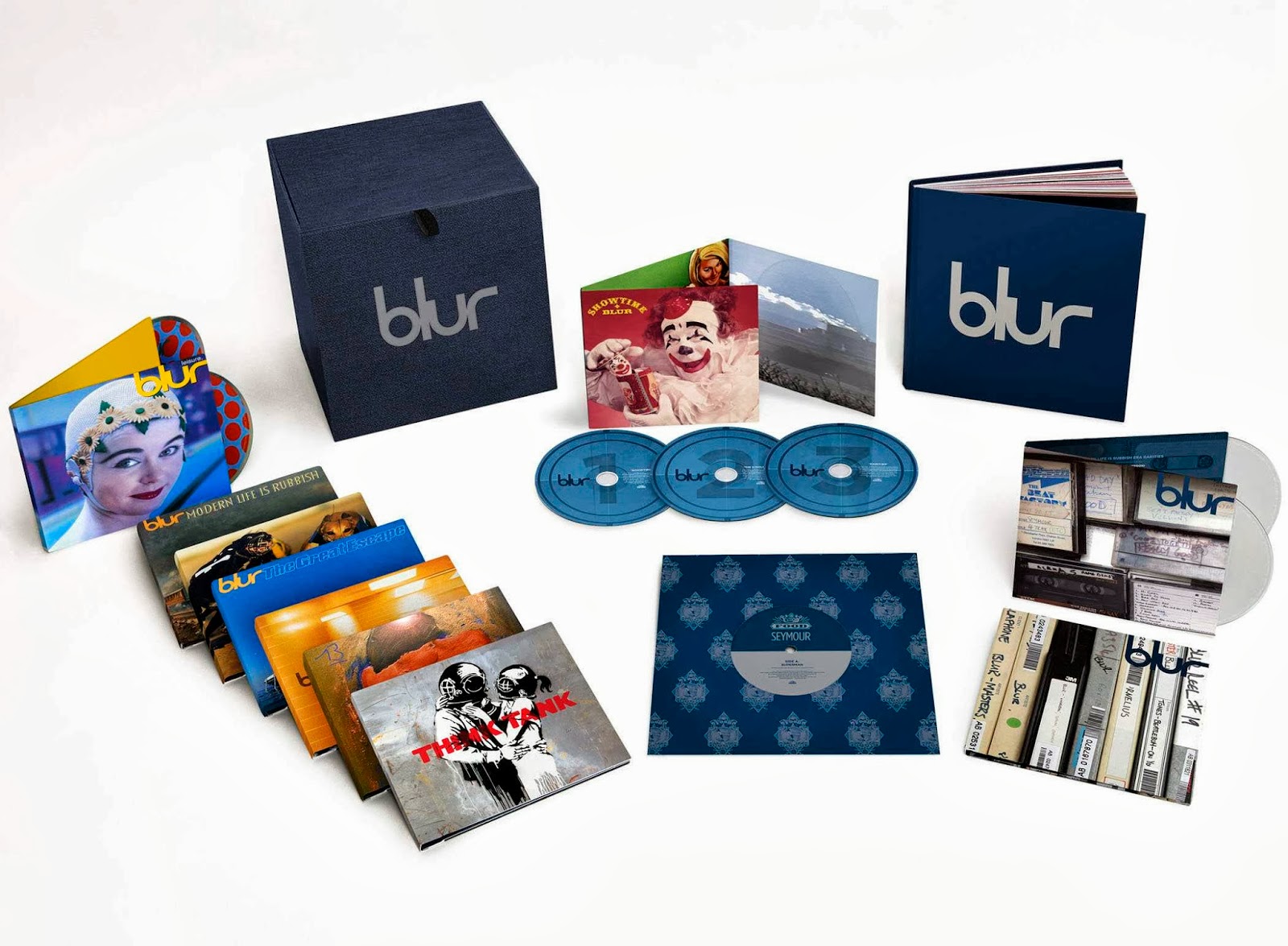
And the sound is amazing. Blur, 13, and Think Thank show a band comfortable with experimenting in new sounds and song structures - less focused on making a great single and more excited about trying something unique. Some tracks from these albums are jams lifted directly from brainstorming sessions or variations on more abrasive sound effects and lyrical experiments. Think Thank learns from the previous two albums' experimentation with a cleaner and more polished delivery. They're definitely eclectic by nature. This is obvious from Parklife on. Each album has its mix of dramatic sweet-songs and high-tempo romps. Last year, 2012, marked the 21-year anniversary of their first album and so they released a career-comprehensive box set of 21 discs (18 CD's and 3 DVD's) which was a mouth-watering prospect for me - I admit: I really love box sets. It was an easy way for me to do a complete, chronological Blur retrospective. I listened to everything, start to finish. It was great to get the full picture and hear, in quick succession, the band's progression through the years. I know. I'm a total music nerd.

Blur 21

So I pulled out the top tracks from their studio albums for my top Blur playlist. I include just a few of the rarities/b-tracks that stand out, although I did find it interesting that for many of their early songs I enjoyed the rare, low-quality demo version much more than the album track. And if you do decide to tackle the list, don't forget to check out their latest 2-song single.

My Blur 21 top playlist:
Sing
Girls & Boys
End of a Century
To The End
Badhead
This Is A Low
Best Days
He Thought of Cars
The Universal
Yuko & Hiro
Bettlebum
Song 2
Country Sad Ballad Man
You're So Great
Strange News From Another Star
Tender
Caramel
I've Got No Distance Left To Run
Ambulance
Crazy Beat
Good Song
Gene By Gene
Battery In Your Leg

From the B-Sides:
All Your Life
Get Out of Cities
Bustin' + Dronin'
Black Book
Money Makes Me Crazy (Marrakech Mix)

2012 Release:
Under the Westway
The Puritan

Thursday, May 16, 2013

Music: My Daft Punk Playlist

The robots. That's how Daft Punk are known by their close friends and associates. How do you take on the persona of an android, putting on robotic head pieces and never appearing in public without them, and still become one of the most well-respected artists in a global genre, producing the most anticipated releases in the industry? Fanboys everywhere in forest trooper helmets might ask the same question. Part of it may be the natural mystique that follows all genuine artists that value their craft over their own craftiness and successfully keep their private life private. So basically Daft Punk are the Bill Watterson of electronic dance music - except before he retired and with shiny, opaque helmets. Maybe that doesn't fit as well as I thought. This French duo, active since the late 80's, represents the best electronic music has to offer, summarizing its strengths in an accessible, shiny package. They are the bionic ambassadors of EDM.

There is an entire world of electronic dance music (EDM to those who know) that is beyond my scope or knowledge. If you don't know anything about electronic music or have always thought you weren't interested, you should know that Daft Punk is EDM for rock lovers (see Digital Love). Daft Punk is not among the founding fathers of the genre, but they introduced it to a wider audience. LCD Soundsystem, for instance, is Daft Punk as an indie garage punk band. At first glance they are quite different. Yet if you like one, you'll find it easy to connect to the other - and that's not even mentioning James Murphy's incessant references to Daft Punk. I can understand the initial aversion to electronic music because the repetition seems thoughtless and boring. But when you consider that music is a condensed representation of time and motion, electronic music utilizes technology to grab moments or feelings, extend them, and change them subtly from one moment to next, attempting to prolong and manipulate what is normally fleeting. And that is why Daft Punk, a pair of self-proclaimed robots, came to the conclusion that the music they create is actually human after all.

Michael Gondry's bizarre yet entertaining video for "Around the World" (1997)

In honor of Daft Punk's upcoming new album Random Access Memories I have for your edification my ultimate Daft Punk playlist. Daft Punk was another one of those discoveries I made early in high school by perusing cdnow.com. Somehow I wound up listening to their first hit "Around the World" and my mind was instantly blown. I had heard electronic music before but always as a soundtrack to a movie or as background music. I'd never considered listening to it for its own sake. Daft Punk brought that genre to the front of my mind. I remember listening to the album on my discman on a band trip when an older kid asked for a listen. I handed him my headphones and he said quizzically, "It's just the same thing over and over again." I didn't really have a response for him because I couldn't explain why he didn't get it - but he didn't. I learned a lot about song structure, form, and details by listening to Daft Punk - there is a pattern and logic that can appeal to the intellectual listener, but of course there are plenty of Burnin' beats as well. Plus you can't help but love a band that takes on their early criticism as their name.

With all the excitement for the new album I've been devling even deeper into the whole Daft Punk world. I was epically rewarded by finding the anime companion movie to Daft Punk's second album, Discovery. Interstella 5555: The 5ecret 5tar 5ystem was an idea spawned during the recording sessions for Discovery that came to fruition in 2003 after a partnership between Daft Punk and French and Japanese filmmakers. I'd seen the music video for One More Time, the album's opening track, but that was years ago and never really thought about the fact that it starts a story but doesn't finish it. As I was revisiting old videos I realized they were all connected and then I found the full movie on vimeo. My face almost melted off I was so excited. It being a family friendly cartoon movie who's score was perhaps the greatest electronic album of all time I sat down with my 2 year old daughter and enjoyed 65 minutes of pure bliss. With no dialogue and only occasional sound effects, it is a visceral experience that follows the musical flow of the album. The fact that something can keep a toddler's full attention for over an hour is not always desirable, but with this it tells me that she takes after her dad with her impeccable taste. Established robot lovers will already know about this gem, but if you have not seen it, follow the vimeo link the first chance you get 65 continuous minutes to yourself and let it wash over you.


And now, my list. This is exhaustive rather than exclusive. The studio album tracks are really the most essential, but the live mashups add another level of awesome if you know the hits. And the fact that they scored TRON: Legacy - perhaps the most critically underrated sci-fi blockbuster of the last ten years - is just a perfect fit. Let me know if you agree or if I missed your favorite track.
  1. Daftendirekt - Homework
  2. Da Funk - Homework
  3. Around the World - Homework
  4. One More Time - Discovery
  5. Aerodynamic - Discovery
  6. Digital Love - Discovery
  7. Harder Better Faster Strong - Discovery
  8. Something About Us - Discovery
  9. Voyager - Discovery
  10. Short Circuit - Discovery
  11. Verdis Quo - Discovery
  12. Human After All - Human After All
  13. Robot Rock - Human After All
  14. Emotion - Human After All
  15. The Prime Time of Your Life - Human After All
  16. Robot Rock / Oh Yeah - Alive 2007
  17. Around The World / Harder Better Faster Stronger - Alive 2007
  18. Face to Face / Short Circuit - Alive 2007
  19. End of Line - TRON: Legacy OST
  20. Derezzed - TRON: Legacy OST

PS - Someday my wife Karen and I are going to do this awesome dance to Harder Better Faster Stronger in some public setting, although we'll be fully clothed.

Friday, March 29, 2013

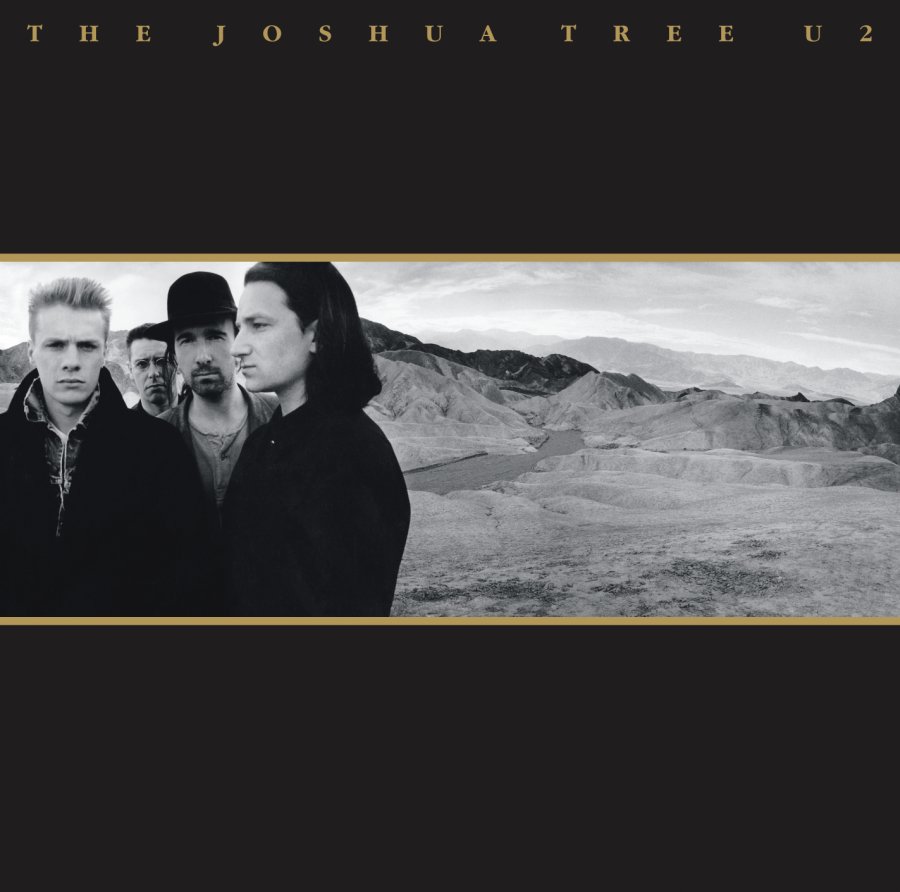
Music: U2 - The Joshua Tree

If you know me at all you know that U2 runs deep for me. I'm an unabashed superfan. I love their music so much that I often don't talk about it for fear I'll come off overzealous and reveal that I'm really just an awkward, raving fan. The love is based in the music, but is supported by the whole story of U2 and who they are as a group. Together now for over 35 years, their membership has never changed since becoming U2. And while its difficult for me to make any claim at best-ness, U2's album The Joshua Tree is the most significant in the story of my devotion to the music of this gang of Irish fellows. And it is the greatest album of all time.

You might say my deeply abiding love for the music of U2 is almost a fluke, induced by a desire to be like cooler, older kids. But I submit that the circumstances that lead to my possession of this album display an innate inclination within myself to U2's music, a practically uncontrollable force. The first time I remember hearing U2 was thanks to MTV's airing of the 500 top music videos of all time (circa 1996). There was a small period where I was a latchkey kid and would come home after school in 5th grade, grab a bowl of cereal and pull up a stool  to the counter and watch TV in the kitchen until my parents came home. This was back when MTV actually played music. Somewhere in the top 100 "With or Without You" came up and I was mesmerized - something clicked. I faintly remembered the little white lettering on the bottom left of the screen identifying the artist, album and song.

The next encounter came during a church youth trip. I was maybe 12. As a caravan of cars we moved from east to west across Montana. Somehow I wound up in a car full of "cool older guys", 16-18 year olds. Why they allowed me join them I didn't know but I was ecstatic and glad to not be in my parent's maroon, boxy Ford Aerostar. I was in the middle in the back seat, too intimidated to do anything other than just sit and listen. They had their portable CD player hooked into the car system and their carefully-organized CD cases. At one point someone asked, "What do you guys want to listen to?" Someone else volunteered, "Let's listen to some U2. Put in The Joshua Tree." My ears perked slightly. I faintly remembered these names from that white text on the tv in my kitchen. Quickly my ears confirmed to me not only that this was the same U2 from the video, but that their music was amazing - this album was amazing. It's name was now ingrained in my long-term memory, even though I wasn't really sure what an album was.

This all came to a culmination when my parents decided to join one of those CD clubs that used to be popular like Columbia House and were offering each of us, their children, an opportunity to pick an album from among the 10 or 12 you get from signing up. Without hesitation I knew: U2's The Joshua Tree. The CD came, and even though I had to borrow my sister's discman and headphones to listen to it, I played it nonstop and, with only the passion that young boys have, I became an undying fan of U2. I'm sure that if I hadn't been watching MTV or hadn't ended up in that car I would've recognized the brilliance of U2's music but my introduction first through The Joshua Tree I find very fitting as it is the seminal work in defining their identity as musicians. They were young, but experienced after having completed four albums and breaking into the US music landscape. They were popular, but without quite yet needing to reflect fully on the monstrous status of celebrity within pop culture(see Achtung Baby through Pop).

Growing up in Eastern Montana I spent a lot of time on long car trips. Whenever on these cross-country journeys I would always pack my trusty discman and my thick  CD case - a very important expression of yourself was your cd collection. Frequently beginning early in the morning, I always knew The Joshua Tree would be my first pick for these trips. With the steady crescendo opening and the energy-inducing, rhythmically-arpeggiated guitar line from The Edge leading up to Bono's opening lines, the rising sun is the most appropriate visual accompaniment to album-opener "Where the Streets Have No Name". Next, the quickly familiar "I Still Haven't Found What I'm Looking For" is only off-putting to those that flatly deny humanity and the mortal experience. The song is yearning for divinity. Then "With or Without You" hits with that alternating ringing track and Adam Clayton's simple, commanding baseline and your face gets serious as you try to adequately express how amazing and serious this music is making you feel without letting anyone else know, but then you let loose, inhibitions aside, as you reel with the exuding lift of the chorus and you feel you kind of know what he means when he says "you give yourself away." At this point my mother turn back towards me with a scolding look saying my music was too loud and everyone else did not want to listen to what I was listening to. No sound-canceling headphones back then.

The Joshua Tree introduced me to the concept of an album as a singular work - a whole piece of art with a structure and parts that are meant to go together. Sure most of the tracks can be enjoyed on their own, but they all share a similar aura that becomes clearer in a complete listen. Originally it was going to be titled "Two Americas", reflecting two conflicting ideas U2 had, and especially Bono, about this new land they'd gotten to know. One was the America as a frontier of hope, receiver of the down-trodden, and distiller of dreams. The other was America as the insistent war machine. Neither perspective was partisan or directly political and when viewed as a whole you get the feeling its told with love. "Bullet the Blue Sky" and "Exit" are most reflective of the "other side" of America with heavy guitars and harsh lyrics.

Somewhere in the transition from "Two Americas" to "Joshua Tree," the American Southwest entered as another influence. It's heard most plainly through the pleading blue-collar village in "Red Hill Milling Town," the quick nymphal desert of "In God's Country," and the dirty bar-room blues of "Twist Through Your Wires." And although a place where the streets have no names may feel like a peaceful utopia, it just as easily invokes the desert. This region, along with the frequent religious references, reveal why the hopeful, outstretched arms of the joshua tree is a fitting symbol for the music.

Every track is golden but "Running To Stand Still" will be the favorite U2 song you've never heard if you don't know this album. There's a story behind some of the imagery in the song, but never mind, you don't need to know it. Starting and ending with the searching plucking that makes you think of a cowboy leaned back on the boardwalk picking at an acoustic guitar, you follow the rise of the piano and tumbling of the low-tom to the pounding peak, and then back down to the closing jailhouse harmonica. I guess all I'm doing is describing the actual music, but doesn't it sound like you just want to listen to it? Rounding out the track listing is the uplifting but painful "One Tree Hill" - written in honor of a friend of the band that passed away - and "Mothers of the Disappeared" - in honor of stolen children and their families in Latin America. Both tell the story of those left behind when the innocent are taken too soon. "Mothers" plays the important role of being the strong, solid closing track. The final song of an album is like the music playing over a movie's credits. It puts the final touch on the work, defining the last impression as something complete and meaningful. If you get up and walk out once the screen goes black you have cut short your experience. Don't make the mistake of cutting short any part of your experience with U2's The Joshua Tree.

Thursday, February 7, 2013

Music: Ryan Adams - Gold

Gold (2001)
No, not Bryan Adams. I'm guessing that at least one of the people reading this might only have heard of Bryan Adams. If through this post I redirect just one person from Bryan Adams to Ryan Adams then the entire existence of this blog up til now is justified. I guess Bryan Adams isn't all that bad... I guess. But I've already dwelt too much on the subject. The focus is Ryan Adams. No "b." Ryan Adams is Top 5 material for me - that is, he is on my list of Top 5 Favorite Artists of All Time. This is a list in my head that fluctuates from time to time - but Ryan is always on it. Not at the top - that's U2 - but he's always there.

And Gold (2001) is my all-time favorite Ryan Adams album. No question. Well... Jacksonville City Nights (2005) might stand shoulder-to-shoulder. But my perspective is kind of unique because among hardcore Ryan Adams fans Gold doesn't usually jump to the top - for some its at the bottom of the heap. Not a surprise as it is his most commercially succesful album - hardcore fans of any group often see that as a negative (the "I liked it before it was popular" syndrome). But it was my first Ryan Adams experience and that usually means something. I can barely remember how I found him. Back when the most popular browser was Netscape I used to spend hours looking for new music on CDnow.com following their "You might also like these artists..." links and downloading song samples on limewire. I think that's how I found it. Dont worry, I always bought the album (if the music was good). I'm kind of traditional that way.

Whether or not it's your first Ryan Adams album or not doesn't matter. Gold is Adams' second studio album and his most eclectic - rich with a classic feeling mix of genre influences including rock, country, and blues. His record company seems to have had some difficulties labeling the album - it was nominated for both rock and country awards at the Grammy's. The video for "New York, New York" played on country music TV channels but most of the album doesn't fit the glossy pop makeover of modern country music - it has more in common with the stuff from a few decades before. I once saw his music as part of a "Renegade Country" endcap at Best Buy, partnered with the likes of Wilco and Brandi Carlile.

The music video for "New York, New York" - filmed just a few days before 9/11

When I say its his most eclectic album I say so knowing full well Adams full career span is prolifically diverse. Active for about 13 years now as a solo artist, he's released 13 full-fledged studio albums, four of which could be classified as double albums, with three releases coming in one year alone (2005's Cold Roses, Jacksonville City Nights, and 29). Each has its own distinct style that stands alone from the others while still being Ryan Adams. One is completely shredder metal. But the rich vintage feel of Gold is probably his most feel-good album.

Although there are no weak points on Gold, Adams' finest stuff is the run from tracks 2-5, which covers everything from heartsick love songs ("Answering Bell", "La Cienega Just Smiled") to rip-roaring harmonica tunes ("Firecracker") to transcendent blues ("Rescue Blues"). Take "Firecracker" for instance. A quick-driving guitar riff, Hammond organs in the back, and a soaring bluesy harmonica whenever Ryan's not singing lyrics like this: "So when does the plane go down? / 'Cause I'm gonna ride it till it hits the ground / Then go out with a fight / 'Cause I just wanna be your baby tonight." It only gets better from there.

Ryan as the quintessential cab driver to the rescue

First these songs loosen you up. Then they excite you. Then they make you blissfully melancholy. And finally they leave you feeling kind of grateful. Some have said the best music, literature, film, art, etc., leaves you changed after you experience it. It invigorates you to the degree that you know its more than just entertainment. You're a different person after experience it. If you're not feeling that after the 9-minute blues journey story-song of "Nobody Girl" or the simple hard-rock driver that is "Enemy Fire" than maybe you just need to turn up the volume or put on some better headphones. I understand that maybe it won't have that effect on you. But maybe you'll get that lovin' feeling. Or maybe I'm just holding on too tightly to that teenage emotion.

Even Bono couldn't resist covering Ryan ("When The Stars Go Blue", track 7)

For the aficionados and Gold-lovers out there look for the deluxe version with an extra disc of songs - Adams originally meant it to be a double album. Seeing as how he's on my Top 5 it really was an obligation for me to get it once I found out about it. There are a couple gems on there. And if you made it this far and you're still wondering when I'm going to talk about "Summer of 69" then please hit the "blog self destruct" button now, as it is clear I have failed you.

Thursday, August 23, 2012

Concert: Wilco - Indianapolis, IN - September 13, 2011

Murat Theater
Indianapolis, IN
September 13, 2011

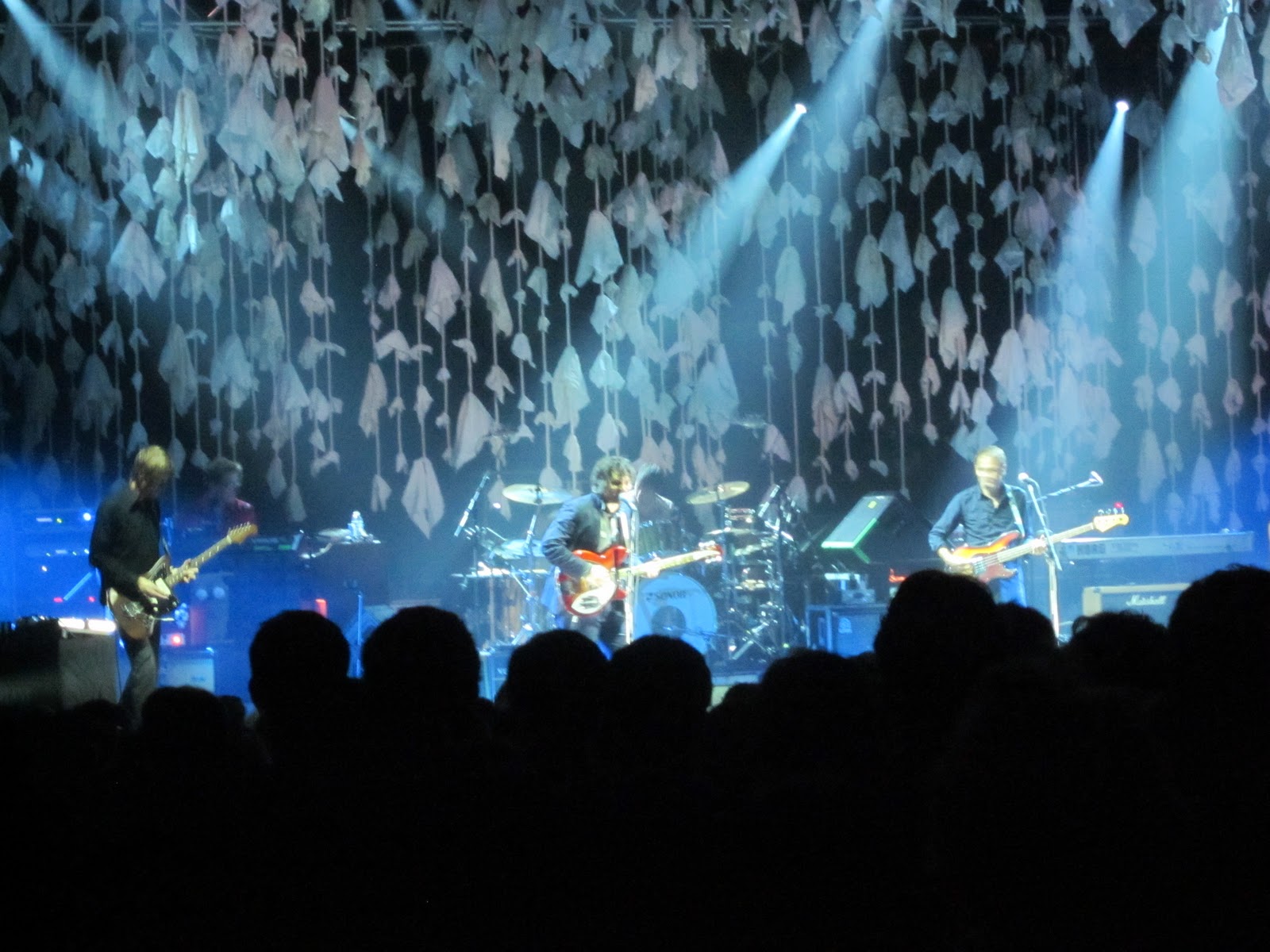
The ghosts of Wilco past


Yes, September 2011. I got that date right. Is it weird to post a review of a concert almost a year after it happened? Probably. I mean, I have this great picture here with the silhouette of the heads in the crowd, Jeff Tweedy and the rest of band with that blue lighting and all those ghosty things hanging all over the stage. It's not a photographic masterpiece by any means, but it reminds me of when I didn't have an iPhone and I don't have an account on Twitter or Tumblr yet so enjoy it. Or not.

I promise I wrote notes on this back then to help me when I actually wrote this post! Here is what I wrote as a prompt that I was supposed to expound upon whenever I wrote my full review:

full sound
electronic feel
community
so solid

Descriptive, I know. I guess it explains itself. This concert was a few weeks before their new album The Whole Love was released and it opened up with Art of Almost which had an electronic, rhythmic feel to it that was a bit of a change for Wilco to me. I've since listened to the new album but it hasn't yet really pulled me in. I suspect I may rediscover it in a year or two.

I also found on this old post some thoughts that Wilco inspired in me about the effectiveness and functions of different media forms:

"The thing that makes music so different from books and movies is that it is a slightly less effective way to tell a story. Film, in my opinion, is the most effective way to tell a story when you want to deliver a more specific message, but each format has its own benefits and drawbacks:

  • Books: level of detail, ability to paint environment, description of inner thought
  • Film: ability to paint/describe environment, rhythm, plot movement/story art
  • Music - rhythm, evoke attitude/essence of environment, direct description of attitude/moral/feeling/emotion, etc.

"To me, music is more about evoking the essence of something, rather than describing in detail what it is or how it got there. Rhythm is a great tool for pushing, suspending, or maintaining a feeling through the use of tempo."

I suppose it must of been pretty deep if it got me thinking that stuff. The concert really was great, besides the drunk people behind us dancing far beyond the limits of their own personal space -- luckily they had to take a lot of smoking breaks. But that's where community comes in. They are big enough to sell out weeks before a new album comes out and they've got everybody chanting "Nothing!" 40 times in a row on Misunderstood, a classic pre-Yankee Hotel Foxtrot song of theirs, popular mostly as a live tune.

As far as "so solid" goes, these are technically proficient musicians and the expanded instrumental sections that you can only get live (intros, bridges, solos, transitions) reflect that the music is at the heart of the performance. Jeff Tweedy feels free and comfortable as the front man, sharing thoughts on the opening act, their music, and the rest of the tour--but you don't go to a Wilco concert for their showmanship. The music was solid and that's what made it great. And the hanging handkerchief ghosts.

Set List: Art of Almost, I Might, Misunderstood, At Least That's What You Said, Bull Black Nova, In A Future Age, I Am Trying To Break Your Heart, Handshake Drugs, War On War, Born Alone, You Are My Face, Impossible Germany, Via Chicago, Dawned On Me, I'm Always In Love, A Shot In the Arm

Encore: Hummingbird, Whole Love, Jesus, etc., Walken, I'm The Man Who Loves You


Friday, July 15, 2011

Concert: David Gray - Live at Kingsbury Hall in Salt Lake


Kingsbury Hall, University of Utah
Salt Lake City, UT
Thursday, July 14, 2011

Sometimes music just washes over you. As you listen the music becomes a wall of sound and you find your thoughts pleasantly drifting. The music acts as a sort of narrator in your mind, setting the tone rather than being the main player. This is distinct from background music, mind you. If you'll pardon a moment of imaginative, ethereal exposition, it could be described as a sonically-induced brainstorm, purposeless, a moment of complete, directionless experience. Except directionless isn't exactly right. The only real lesson I remember from my high school choir teacher was that music is motion, it is always going somewhere. Last night at Kingsbury Hall David Gray suspended the motion for a moment with a breathtaking performance. Gray's stop in Salt Lake was the last of the Lost and Found Tour in support of his 2010 album Foundling. Most Graylings (as I have decided to dub his fans) would describe the night as magical.

I understand that not everyone likes David Gray. Some describe his music as slow or boring. If you feel that way you might not enjoy Foundling, a beautiful album reflecting a subtle progression of the classic Gray style. I would argue that the music is exciting, although the excitement is refined and gradual. It certainly is enhanced in its performance. As he played, switching from song to song between the piano and the acoustic guitar, the physical energy expressed itself most visibly through the constant side-to-side rocking of his head, a sort of trademark. The best description of the man himself, at least during his show, is charming. He speaks little and when he does he is grateful, self-aggrandizing, and humorous.


I came to this concert without a complete familiarity with his backlog of recordings. The albums I own complete are White Ladder (1999) and his latest, Foundling (2010), and I am also familiar with a majority of 2009's Draw the Line. That release's opening track "Fugitive" is his most recent semi-popular single. This concert inspired me to complete my David Gray collection, which means catching up on 6 1/2 albums or so. A couple of the tunes I was unfamiliar with, which are classic fan favorites to those who know, really made an impression on me. I speak of "Lately," a song that gradually crescendos into a raucous and joyous extended climax. I also speak of the emotionally evocative Debauchery, which I almost didn't notice until I realized everyone else was enthralled, pleased to hear what I gather is a rarely played piece from his 1993 debut album A Century Ends.

The one disappointment for the night was the absence of "Please Forgive Me," his other hit during the White Ladder era when "Babylon" brought Gray more attention than he's had before or since. This was the song that made me a David Gray fan when I saw him play it on Austin City Limits on PBS in 2001. I remember his drummer had a buoyant character about him. I looked all over the show's website and online for the performance but, unfortunately, it probably only exists deep in some archive. I will forgive him, though, despite that omission, for the superb performance he put on at Kingsbury Hall.

Set List: Foundling, Only the Wine, My Oh My, Lately, Kathleen, Fugitive, A New Day At Midnight, The One I Love, Draw The Line, Nemesis, Holding On, Falling Free (solo piano), Debauchery (solo guitar), Living Room, Flame Turns Blue, Alibi, White Ladder, Babylon
Encore: This Year's Love, Sail Away