Carney has made himself the resident expert of a certain subgenre of musical film using the possibility of music as a career to therapeutically tackle and trascend whatever difficult situations life throws at you. Music is sound-in-motion, and paired with the medium of film--or pictures-in-motion--has been an exciting combination since it was first conceived. Music videos, while becoming a distinct short-form art medium delivering pop culture at scale through MTV in the 80's, have always been a part of film since sound was incorporated in some way. While silent film had a different soundtrack every time it played depending on who your house organist was, that flexibility allowed it to be always changing. The moment sound was added to movies music came right along (The Jazz Singer, 1927). In fact, one of the most timeless movies of all time, Singin In The Rain, is about the story of sound and music in film. While true musicals are few and far between nowadays (La La Land just stole our hearts) music in film as both a storytelling tool and as a narrative subject has never been better.
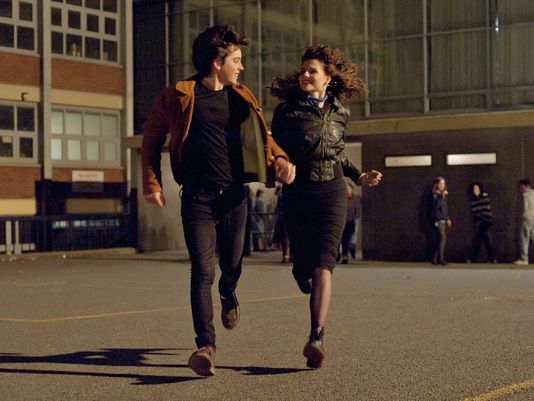
Sing Street takes this to the limit with it's surprisingly moving storyline about a young man and woman in Ireland in the 80's. The economic crisis there is dire and families are suffering. Conor Lawlor, our protagonist, is forced to attend a lower-class school as his parents work through marital and financial troubles. What I love most about Conor is that even as a generally introverted character, he has bravado in the moments that count and through that he becomes an unexpected leader. When he sees a pretty girl on the stoop across from his new school he builds the courage to talk to her and then, in a moment of desperation, he lies that he has a band and that she'd be good in their new video. As he walks away after having successfully gotten her number he hastily whispers to his friend, "We need to form a band." He's good at making it up as he goes along in the fake it till you make it category.

The core of Conor's journey in the film is his relationships with the girl, Raphina, and his brother. In both of them he sees a level of experience and worldliness that he seeks after while both learn unexpected lessons from his less-cynical and free spirit. The relationship with his older brother, Brendan, is one of the sweetest and most encouraging parts of the movie. How Brendan chooses to assist Conor in freeing himself from the confines of their complicated home life is one of the greatly nuanced and mature aspects of the story. He helps Connor see his parents from a more adult point-of-view that both helps him appreciate their struggles and recognize their flaws. Brendan also tells him step by step what he needs to do if he's going to be successful in using music to get girls. He asks, "You want to have actual sexual intercourse, right?" Connor is confused, "Yeah. Wait, what?". "The girl, it's all about the girl, isn't it?" Brendan asks. Conor obviously hadn't quite fully considered his more innocent intentions. This is a pretty basic part of the older brother job description (and probably why I never had any luck in that area in high school, not having any brothers).
One of the continual joys of the film is the many ways creativity and song-writing become the choice Connor uses to deal with a situation. Whether he's anxious to impress a girl, angry at all the oppressive forces at school, stressed about his family situation, deliriously happy, or working through any other number of things, he uses music as a positive tool to process what he's feeling. And we benefit. Songwriting team Carney and Gary Clark channel the 80's feel but with a modern sensitivity that makes the original songs instantly lovable. After watching Sing Street I went right out and bought the soundtrack. While it includes several of the genuine 80's songs used throughout the movie from groups like Duran Duran and Motorhead, I skip over those and go straight for the originals. Carney prioritized casting actual musicians so the group of kids are more genuine in their performances. They sound great.
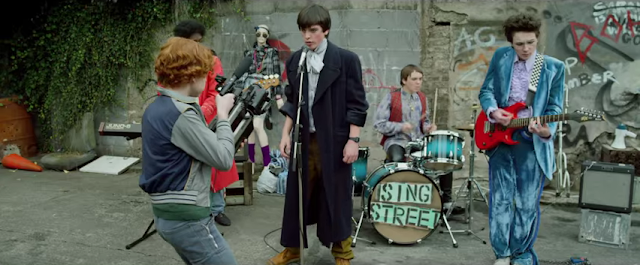
Within the film, the songwriting scenes are some of the most enjoyable to watch. There's the typical "get the band together" sequence where Conor and his new friend Mark round up all the musicians they know to create a ragtag group. Mark is the resident "real" musician and seems to know how to play every instrument under the sun. He becomes Conor's song-writing partner. By the end of the film you get excited every time Conor shows up at Mark's door to write a song. In a similar fashion to the scene in Begin Again where Mark Ruffalo's character envisions a full band accompanying Keira Knightley's solo acoustic performance, we'll see a time lapse of the writing of a song as you hear it with new band members joining in at key points as it develops. And combining Carney's own loves for both film and music, the music video sequences are especially joyful and hilariously cheesy.
While I've heard others disparage the ending of Sing Street, I don't know what they see. Without giving it away, the very final scenes, accompanied by a great song sung by Adam Levine (and co-written by Levin, Carney, and Once's Glen Hansard), it captures symbolically the hope and uncertainty of youth and someone determined to give his dream a chance when the odds are slim. It is the emotional climax, well-earned from the depth of relationships and struggle that Conor experiences throughout the film's story centered on both romantic and brotherly love.
Streaming now on Netflix
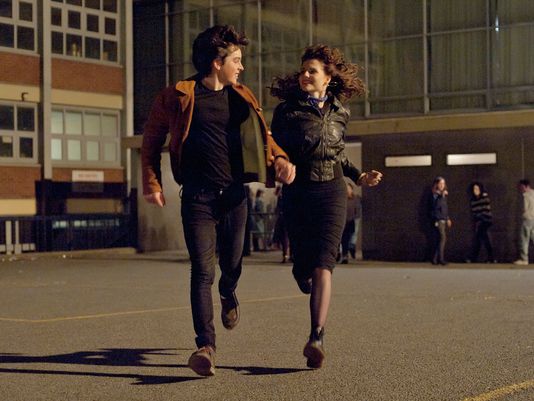

The core of Conor's journey in the film is his relationships with the girl, Raphina, and his brother. In both of them he sees a level of experience and worldliness that he seeks after while both learn unexpected lessons from his less-cynical and free spirit. The relationship with his older brother, Brendan, is one of the sweetest and most encouraging parts of the movie. How Brendan chooses to assist Conor in freeing himself from the confines of their complicated home life is one of the greatly nuanced and mature aspects of the story. He helps Connor see his parents from a more adult point-of-view that both helps him appreciate their struggles and recognize their flaws. Brendan also tells him step by step what he needs to do if he's going to be successful in using music to get girls. He asks, "You want to have actual sexual intercourse, right?" Connor is confused, "Yeah. Wait, what?". "The girl, it's all about the girl, isn't it?" Brendan asks. Conor obviously hadn't quite fully considered his more innocent intentions. This is a pretty basic part of the older brother job description (and probably why I never had any luck in that area in high school, not having any brothers).
One of the continual joys of the film is the many ways creativity and song-writing become the choice Connor uses to deal with a situation. Whether he's anxious to impress a girl, angry at all the oppressive forces at school, stressed about his family situation, deliriously happy, or working through any other number of things, he uses music as a positive tool to process what he's feeling. And we benefit. Songwriting team Carney and Gary Clark channel the 80's feel but with a modern sensitivity that makes the original songs instantly lovable. After watching Sing Street I went right out and bought the soundtrack. While it includes several of the genuine 80's songs used throughout the movie from groups like Duran Duran and Motorhead, I skip over those and go straight for the originals. Carney prioritized casting actual musicians so the group of kids are more genuine in their performances. They sound great.
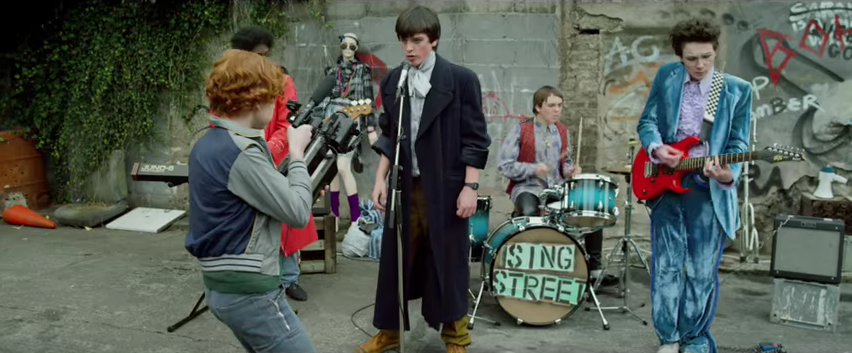
Within the film, the songwriting scenes are some of the most enjoyable to watch. There's the typical "get the band together" sequence where Conor and his new friend Mark round up all the musicians they know to create a ragtag group. Mark is the resident "real" musician and seems to know how to play every instrument under the sun. He becomes Conor's song-writing partner. By the end of the film you get excited every time Conor shows up at Mark's door to write a song. In a similar fashion to the scene in Begin Again where Mark Ruffalo's character envisions a full band accompanying Keira Knightley's solo acoustic performance, we'll see a time lapse of the writing of a song as you hear it with new band members joining in at key points as it develops. And combining Carney's own loves for both film and music, the music video sequences are especially joyful and hilariously cheesy.
While I've heard others disparage the ending of Sing Street, I don't know what they see. Without giving it away, the very final scenes, accompanied by a great song sung by Adam Levine (and co-written by Levin, Carney, and Once's Glen Hansard), it captures symbolically the hope and uncertainty of youth and someone determined to give his dream a chance when the odds are slim. It is the emotional climax, well-earned from the depth of relationships and struggle that Conor experiences throughout the film's story centered on both romantic and brotherly love.
Streaming now on Netflix