Thursday, May 16, 2013

Music: My Daft Punk Playlist

The robots. That's how Daft Punk are known by their close friends and associates. How do you take on the persona of an android, putting on robotic head pieces and never appearing in public without them, and still become one of the most well-respected artists in a global genre, producing the most anticipated releases in the industry? Fanboys everywhere in forest trooper helmets might ask the same question. Part of it may be the natural mystique that follows all genuine artists that value their craft over their own craftiness and successfully keep their private life private. So basically Daft Punk are the Bill Watterson of electronic dance music - except before he retired and with shiny, opaque helmets. Maybe that doesn't fit as well as I thought. This French duo, active since the late 80's, represents the best electronic music has to offer, summarizing its strengths in an accessible, shiny package. They are the bionic ambassadors of EDM.

There is an entire world of electronic dance music (EDM to those who know) that is beyond my scope or knowledge. If you don't know anything about electronic music or have always thought you weren't interested, you should know that Daft Punk is EDM for rock lovers (see Digital Love). Daft Punk is not among the founding fathers of the genre, but they introduced it to a wider audience. LCD Soundsystem, for instance, is Daft Punk as an indie garage punk band. At first glance they are quite different. Yet if you like one, you'll find it easy to connect to the other - and that's not even mentioning James Murphy's incessant references to Daft Punk. I can understand the initial aversion to electronic music because the repetition seems thoughtless and boring. But when you consider that music is a condensed representation of time and motion, electronic music utilizes technology to grab moments or feelings, extend them, and change them subtly from one moment to next, attempting to prolong and manipulate what is normally fleeting. And that is why Daft Punk, a pair of self-proclaimed robots, came to the conclusion that the music they create is actually human after all.

Michael Gondry's bizarre yet entertaining video for "Around the World" (1997)

In honor of Daft Punk's upcoming new album Random Access Memories I have for your edification my ultimate Daft Punk playlist. Daft Punk was another one of those discoveries I made early in high school by perusing cdnow.com. Somehow I wound up listening to their first hit "Around the World" and my mind was instantly blown. I had heard electronic music before but always as a soundtrack to a movie or as background music. I'd never considered listening to it for its own sake. Daft Punk brought that genre to the front of my mind. I remember listening to the album on my discman on a band trip when an older kid asked for a listen. I handed him my headphones and he said quizzically, "It's just the same thing over and over again." I didn't really have a response for him because I couldn't explain why he didn't get it - but he didn't. I learned a lot about song structure, form, and details by listening to Daft Punk - there is a pattern and logic that can appeal to the intellectual listener, but of course there are plenty of Burnin' beats as well. Plus you can't help but love a band that takes on their early criticism as their name.

With all the excitement for the new album I've been devling even deeper into the whole Daft Punk world. I was epically rewarded by finding the anime companion movie to Daft Punk's second album, Discovery. Interstella 5555: The 5ecret 5tar 5ystem was an idea spawned during the recording sessions for Discovery that came to fruition in 2003 after a partnership between Daft Punk and French and Japanese filmmakers. I'd seen the music video for One More Time, the album's opening track, but that was years ago and never really thought about the fact that it starts a story but doesn't finish it. As I was revisiting old videos I realized they were all connected and then I found the full movie on vimeo. My face almost melted off I was so excited. It being a family friendly cartoon movie who's score was perhaps the greatest electronic album of all time I sat down with my 2 year old daughter and enjoyed 65 minutes of pure bliss. With no dialogue and only occasional sound effects, it is a visceral experience that follows the musical flow of the album. The fact that something can keep a toddler's full attention for over an hour is not always desirable, but with this it tells me that she takes after her dad with her impeccable taste. Established robot lovers will already know about this gem, but if you have not seen it, follow the vimeo link the first chance you get 65 continuous minutes to yourself and let it wash over you.


And now, my list. This is exhaustive rather than exclusive. The studio album tracks are really the most essential, but the live mashups add another level of awesome if you know the hits. And the fact that they scored TRON: Legacy - perhaps the most critically underrated sci-fi blockbuster of the last ten years - is just a perfect fit. Let me know if you agree or if I missed your favorite track.
  1. Daftendirekt - Homework
  2. Da Funk - Homework
  3. Around the World - Homework
  4. One More Time - Discovery
  5. Aerodynamic - Discovery
  6. Digital Love - Discovery
  7. Harder Better Faster Strong - Discovery
  8. Something About Us - Discovery
  9. Voyager - Discovery
  10. Short Circuit - Discovery
  11. Verdis Quo - Discovery
  12. Human After All - Human After All
  13. Robot Rock - Human After All
  14. Emotion - Human After All
  15. The Prime Time of Your Life - Human After All
  16. Robot Rock / Oh Yeah - Alive 2007
  17. Around The World / Harder Better Faster Stronger - Alive 2007
  18. Face to Face / Short Circuit - Alive 2007
  19. End of Line - TRON: Legacy OST
  20. Derezzed - TRON: Legacy OST

PS - Someday my wife Karen and I are going to do this awesome dance to Harder Better Faster Stronger in some public setting, although we'll be fully clothed.

Friday, March 29, 2013

Music: U2 - The Joshua Tree

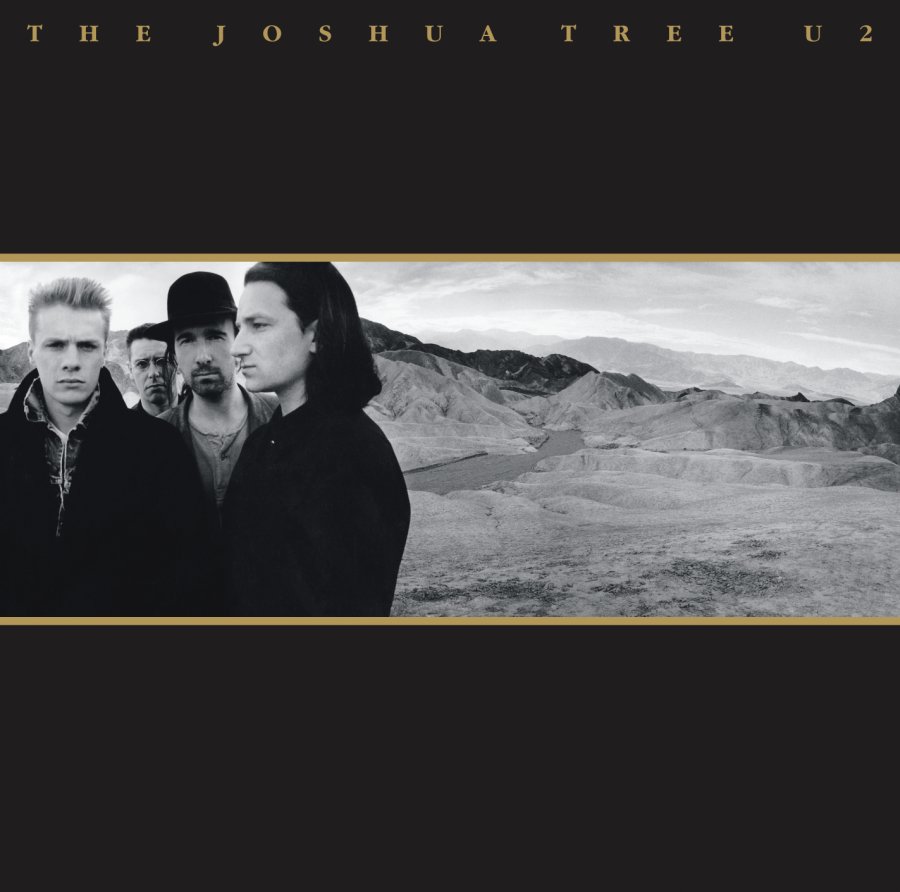
If you know me at all you know that U2 runs deep for me. I'm an unabashed superfan. I love their music so much that I often don't talk about it for fear I'll come off overzealous and reveal that I'm really just an awkward, raving fan. The love is based in the music, but is supported by the whole story of U2 and who they are as a group. Together now for over 35 years, their membership has never changed since becoming U2. And while its difficult for me to make any claim at best-ness, U2's album The Joshua Tree is the most significant in the story of my devotion to the music of this gang of Irish fellows. And it is the greatest album of all time.

You might say my deeply abiding love for the music of U2 is almost a fluke, induced by a desire to be like cooler, older kids. But I submit that the circumstances that lead to my possession of this album display an innate inclination within myself to U2's music, a practically uncontrollable force. The first time I remember hearing U2 was thanks to MTV's airing of the 500 top music videos of all time (circa 1996). There was a small period where I was a latchkey kid and would come home after school in 5th grade, grab a bowl of cereal and pull up a stool  to the counter and watch TV in the kitchen until my parents came home. This was back when MTV actually played music. Somewhere in the top 100 "With or Without You" came up and I was mesmerized - something clicked. I faintly remembered the little white lettering on the bottom left of the screen identifying the artist, album and song.

The next encounter came during a church youth trip. I was maybe 12. As a caravan of cars we moved from east to west across Montana. Somehow I wound up in a car full of "cool older guys", 16-18 year olds. Why they allowed me join them I didn't know but I was ecstatic and glad to not be in my parent's maroon, boxy Ford Aerostar. I was in the middle in the back seat, too intimidated to do anything other than just sit and listen. They had their portable CD player hooked into the car system and their carefully-organized CD cases. At one point someone asked, "What do you guys want to listen to?" Someone else volunteered, "Let's listen to some U2. Put in The Joshua Tree." My ears perked slightly. I faintly remembered these names from that white text on the tv in my kitchen. Quickly my ears confirmed to me not only that this was the same U2 from the video, but that their music was amazing - this album was amazing. It's name was now ingrained in my long-term memory, even though I wasn't really sure what an album was.

This all came to a culmination when my parents decided to join one of those CD clubs that used to be popular like Columbia House and were offering each of us, their children, an opportunity to pick an album from among the 10 or 12 you get from signing up. Without hesitation I knew: U2's The Joshua Tree. The CD came, and even though I had to borrow my sister's discman and headphones to listen to it, I played it nonstop and, with only the passion that young boys have, I became an undying fan of U2. I'm sure that if I hadn't been watching MTV or hadn't ended up in that car I would've recognized the brilliance of U2's music but my introduction first through The Joshua Tree I find very fitting as it is the seminal work in defining their identity as musicians. They were young, but experienced after having completed four albums and breaking into the US music landscape. They were popular, but without quite yet needing to reflect fully on the monstrous status of celebrity within pop culture(see Achtung Baby through Pop).

Growing up in Eastern Montana I spent a lot of time on long car trips. Whenever on these cross-country journeys I would always pack my trusty discman and my thick  CD case - a very important expression of yourself was your cd collection. Frequently beginning early in the morning, I always knew The Joshua Tree would be my first pick for these trips. With the steady crescendo opening and the energy-inducing, rhythmically-arpeggiated guitar line from The Edge leading up to Bono's opening lines, the rising sun is the most appropriate visual accompaniment to album-opener "Where the Streets Have No Name". Next, the quickly familiar "I Still Haven't Found What I'm Looking For" is only off-putting to those that flatly deny humanity and the mortal experience. The song is yearning for divinity. Then "With or Without You" hits with that alternating ringing track and Adam Clayton's simple, commanding baseline and your face gets serious as you try to adequately express how amazing and serious this music is making you feel without letting anyone else know, but then you let loose, inhibitions aside, as you reel with the exuding lift of the chorus and you feel you kind of know what he means when he says "you give yourself away." At this point my mother turn back towards me with a scolding look saying my music was too loud and everyone else did not want to listen to what I was listening to. No sound-canceling headphones back then.

The Joshua Tree introduced me to the concept of an album as a singular work - a whole piece of art with a structure and parts that are meant to go together. Sure most of the tracks can be enjoyed on their own, but they all share a similar aura that becomes clearer in a complete listen. Originally it was going to be titled "Two Americas", reflecting two conflicting ideas U2 had, and especially Bono, about this new land they'd gotten to know. One was the America as a frontier of hope, receiver of the down-trodden, and distiller of dreams. The other was America as the insistent war machine. Neither perspective was partisan or directly political and when viewed as a whole you get the feeling its told with love. "Bullet the Blue Sky" and "Exit" are most reflective of the "other side" of America with heavy guitars and harsh lyrics.

Somewhere in the transition from "Two Americas" to "Joshua Tree," the American Southwest entered as another influence. It's heard most plainly through the pleading blue-collar village in "Red Hill Milling Town," the quick nymphal desert of "In God's Country," and the dirty bar-room blues of "Twist Through Your Wires." And although a place where the streets have no names may feel like a peaceful utopia, it just as easily invokes the desert. This region, along with the frequent religious references, reveal why the hopeful, outstretched arms of the joshua tree is a fitting symbol for the music.

Every track is golden but "Running To Stand Still" will be the favorite U2 song you've never heard if you don't know this album. There's a story behind some of the imagery in the song, but never mind, you don't need to know it. Starting and ending with the searching plucking that makes you think of a cowboy leaned back on the boardwalk picking at an acoustic guitar, you follow the rise of the piano and tumbling of the low-tom to the pounding peak, and then back down to the closing jailhouse harmonica. I guess all I'm doing is describing the actual music, but doesn't it sound like you just want to listen to it? Rounding out the track listing is the uplifting but painful "One Tree Hill" - written in honor of a friend of the band that passed away - and "Mothers of the Disappeared" - in honor of stolen children and their families in Latin America. Both tell the story of those left behind when the innocent are taken too soon. "Mothers" plays the important role of being the strong, solid closing track. The final song of an album is like the music playing over a movie's credits. It puts the final touch on the work, defining the last impression as something complete and meaningful. If you get up and walk out once the screen goes black you have cut short your experience. Don't make the mistake of cutting short any part of your experience with U2's The Joshua Tree.

Monday, March 18, 2013

Film: Howl's Moving Castle

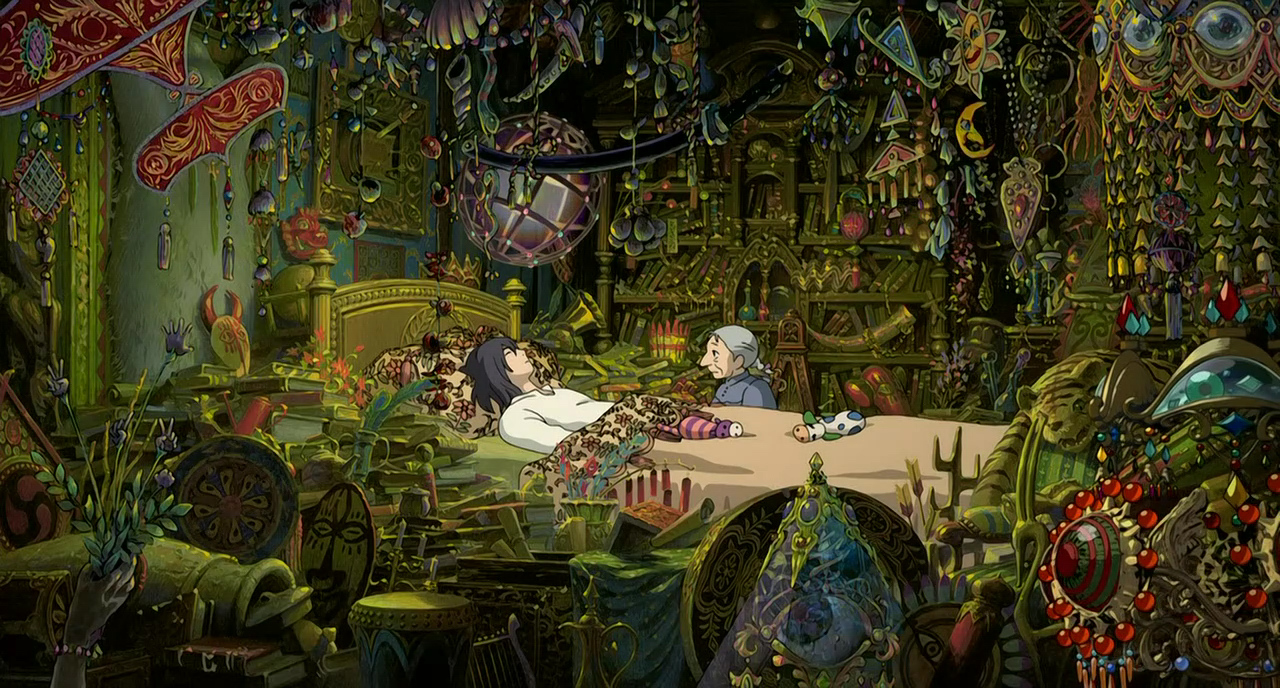
Hayao Miyazaki’s groundbreaking animated films, like Princess Mononoke and Spirited Away, can be described as sweeping, fantastical, and heart-wrenchingly joyful. Equally epic, Miyazaki’s 2004 film Howl’s Moving Castle, adapted from Diana Wynne Jones’ book of the same name, renders the viewer immobilized through the experience of a young girl on a journey of discovery. The film reaffirmed Miyazaki's role as the global ambassador of Japanese animation. He is a visionary man who understands that discovering an alternative side of life can be a revitalizing experience, and in that sense sends his audience right along with his characters.

The film begins in a world at war, with soldiers marching the streets of a vaguely European-feeling town and strange planes flying overhead. Young Sophie works in a hat shop and bumps into Howl, a known wizard and local heartthrob  She quickly falls into a world of magic and finds trouble when the Witch of the Waste binds her with a spell of old age. In her newly geriatric state she goes in search of Howl. His house, a walking, magic fortress serves as his headquarters and main point of departure for his war-related missions. Now known as Grandma Sophie, she enlists herself as his maid and finds a place among the other housemates: a young apprentice, a cute but paranormally complex and load-bearing fire demon, a silent scarecrow, and later, a humbled Witch of the Waste. While adjusting to her newly-aged body, Sophie's youthful heart deals with identity and love. Howl, a tenacious wizard full of defiance and destructive power, is caught in his own difficulties. Dealing with pacifism in wartime, he has become a political casualty of the raging conflict. The struggles crescendo and combine - as they are often wont to do - and the characters face difficult, life-changing choices. The whole things comes together in classic Miyazaki style.

Just your average mobile home

Is this starting to sound a little too "magical" for you? Maybe you think its just for kids? Well grow up and accept that some children's movies are even better for adults. This film was released on the tailwind of Miyazaki’s most globally recognized film, Spirited Away, which had just become the first anime film to win the Academy Award for Best Animation. The two films, along with most of his movies, communicate many of the same themes. Howl, which set box office records in its own right, was highly influenced both by the previous success of Spirited Away - still the highest grossing Japanese film of all time - and by Miyazaki’s own reactions to the beginning of the Iraq War. He has been classified as a pacifist, feminist, and traditionalist - all perspectives that inform his characters and their struggles. But the moralistic view of his stories is more universal than partisan. In this film Howl's struggles are treated more as personal than political.


While there are lessons to be learned from Howl’s demons, Sophie’s character growth is equally poignant as she decides to optimistically accept the challenge of old age. Her quick transformation from young adult to elderly is one most youth would not accept lightly, and Miyazaki helps the viewer to reflect on age and identity as he explores how Sophie deals with instant maturity and physical limitation. She finds she's able to gradually shed the years by embracing life and its challenges rather than complaining about them. Love, energy, and wisdom come as she is forced to accept things she cannot change and address those she can. Life in Howl's mystical mobile home is lived a few steps away from normality. Time and space have no constancy. The resulting mobility, while exciting, has kept Howl and his housemates from facing reality. Sophie breathes some fresh air into the place as she takes responsibility and learns to value the moment and the relationships that surround her. 


If you've never seen a Miyazaki film before you might initially be resistant to the style of animation, the story, or the fantasy elements. If so, I urge you to let go and soak it all in. I prefer watching in Japanese with English subtitles. When coupled with the beautiful, melancholy score it completes the cultural journey and give you a truly foreign experience. If you just can't handle reading while watching, or you are enjoying it with kids, turn on the translation. John Lasseter - Miyazaki's championing superfan in the US - and his team at Disney went to significant lengths to make a quality English translation including revisiting the dialogue and recording voiceover work by critically acclaimed actors. Most notable is Christian Bale, who gives Howl's voice that dark, raspy Batman quality which we American's just seem to love.


This film is a gem during which I always sit in constant amazement. The beguiling blend of music, love, magic, and visuals creates an orchestral experience. Sometimes a film's ability to take you somewhere completely different is more valuable than the message it communicates. Howl's Moving Castle does both with ease. Walking away from the film you'll have a heightened sense of wonder at the richness of the world around you. Just as Miyazaki's characters rarely finish a film in the same form they began it, you'll be closer to internalizing the fact that life is always changing. And maybe you'll see the young person inside the next old face you see.