Since its release last weekend I've seen
Gravity described as the masterpiece of Mexican filmmaker Alfonso Cuarón. It is. It's a visually astonishing film that cohesively uses all its elements - cinematography, sound, acting, plot, visual effects, etc. - to tell a beautiful, and gripping story. While at face value it's a thrilling portrayal of a perilous struggle for survival,
Gravity offers a deeper exploration into how each of us deals with adversity in life.
When I first saw the
teaser trailer for
Gravity I was instantly enthralled and excited. A couple of things stood out to me. First, I was in the theater when I saw it so I got the full audiovisual experience and the film looked beautiful and thrilling. I was instantly gripped, even though I really had no idea what it was about - no more than astronauts in trouble in space. The second thing I noticed were the names attached to it. Alfonso Cuarón is an increasingly recognized director with only a few titles under his belt, but they are diverse and told with style and meaning (He directed the best Harry Potter film,
Prisoner of Azkaban, among other things). Seeing something so different with his name on it is good reason to get excited. Sandra Bullock and George Clooney are both great actors as well. Expectations were forming and I had a hunch this was going to be great. My ears were perked and I was paying close attention. I was dying to see it. That's what a good trailer does.
It met my expectations.
Gravity's storytelling is efficient. Everything is tied to the ultimate purpose of the story and the characters. I just have to say thank you to Cuarón for doing that so well. Most great movies do it, but few big budget flicks are among them. It opens with three astronauts during a spacewalk. The shuttle Explorer is attached to the Hubble satellite and Dr. Ryan Stone (Sandra Bullock) is installing some hardware to assist in her research. It's her first time in space and Mission Control is getting readings indicating she's feeling a bit queasy. Matt Kowalski (George Clooney), on the other hand, is a seasoned veteran astronaut and zooms around with confidence. A third member of the team is enjoying himself as well. He's a nice guy with a family and you know instantly he is not making it out of this alive. The voice of Mission Control (Ed Harris... yes, the guy that was the head of Mission Control in Apollo 13... if you were paying attention) lets them know a Russian satellite was destroyed and has created some debris but no need to worry. Oh wait... yes there is need to worry. They get hit by a field of high velocity space shrapnel. Ryan is flung into space completely detached from the shuttle and her team. She starts to panic. Matt tries to settle her down on the radio but she can barely breathe.
This is all in the trailer. From there it's a series of obstacles that must be overcome one by one, each promising a great likelihood of failure and death. This is where we really get to know these characters and learn from their different approaches at dealing with extreme adversity. Because that's what
Gravity is all about. It's a beautiful and extensive series of metaphors on life and how to deal with the unwelcome and unexpected. The movie is enjoyable as it is without the reflection, but some pondering may deepen its emotional impact. Dr. Stone has some difficult things from her past and has shut out the rest of the world. This seems to make the silence of space appealing to her. Matt is more fun-loving but with a sure will to survive and an unbreakable calm. There's going to be some real anxiety as you watch and consider how you would react in the same situation. You tell yourself these people have been trained for this, but only a true acceptance of the reality of death and life can really allow you to make jokes and listen to twangy country music as you drift in space with your oxygen ticking below 5%.
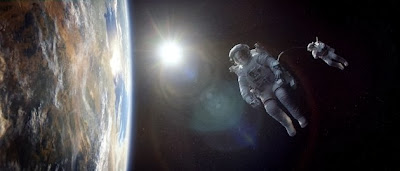
The physical situation in which Ryan Stone finds herself is symbolic of her emotional relationship with life and the rest of the human race. Isolated. Silent. Hopeless. As you watch you may begin to wonder if it mirrors aspects of your own life. Not in a desperate depressing sort of way, but in that this mortal life we all wander through, the chance for disaster is upon us at any moment and once it strikes - whatever flavor adversity comes in - it's hard to imagine that most people wouldn't panic too. Maybe it would be easiest to just drift off. To let go. It's a lot of work to stay afloat. Ryan must make a decision that most of us are never confronted with: to hold on to or let go of gravity. By the end of the film we learn that rather than the shared bond between two masses, gravity is also the shared bond between each of us and the rest of the human race (perhaps even a higher power?). The choice we are faced with is to hold on and accept gravity - despite all the weight that comes with that choice - or to let go and drift away.
---
Sandra Bullock does a brilliant job. A little bit of research will tell you about the physical training she did for months to prepare for the role. What's more impressive about it too is how it's tied to her performance. The panic, the breathing, the distress, is all so authentic it hardly seems like acting but it's all rehearsed and practiced down to the rhythm and the depth of each gasp of air. Clooney is, of course, great. Cuarón likes long, moving shots which required precise sequences of motion from both actors. I think Bullock, though, is deserving of special attention for her role.
 |
| Maybe it would be easier to just drift away... |
The cinematography was ground-breaking. Those long shots serve the story well as the unbroken motion from far back, to up-close, moving seamlessly from third-person perspective to first-person perspective inside the suit. You might not notice it, but that's quite alright. That style keeps you focused on the action while still giving you the full spectrum of what is happening without breaking the visual focus. The sound is right on, also flowing from one perspective to the next, while never creating a false environment by putting sound where it doesn't belong. Indeed, the most intense visual action is often made eerily serene as you witness the destruction happening in the silence of space. And the music, while not often present, hits the right notes at the right time, bringing the emotional journey all the way home in just the precise moments. Steven Price gets the top music credit and I think he's one to watch. Although he's worked on a number of impressive productions, he's relatively new to taking the lead.
But the full credit for this film's
gravitas (get it) will fall on the shoulder's of Alfonso Cuarón. He fills or shares most of the top production credits as Director, Producer, Writer and Editor. The writing credit is shared with his son, Jonas. A quick perusal of Cuarón's (Alfonso, not Jonas)
IMDb page reveals his two biggest aspirations in his youth were to become an astronaut and a filmmaker. This film seems like a culmination of his career thus far and a jumping-off point for the next phase. At a time when Hollywood seems all about creating soulless sequels pumped up to 3D to drive more revenue, the existence and box-office success of
Gravity, a film whose soul purpose is to serve a beautiful story of redemption and building hope in life, dually builds a bit of hope in an industry that must not have it
all wrong if it can put someone like Alfonso Cuarón at the helm of a production.
A note on 3D: As it was released
Gravity became another one of those films that makes a lot of people that normally don't like 3D say, "This is a good argument for the validity of 3D." That caught my attention. I had the pleasure of seeing the film in IMAX 3D in a true, full-size IMAX theater. I'd recommend doing the same while its still in theaters. It was a really exciting, immersive experience.


