Tuesday, February 12, 2013

Book: Casino Royale

First Edition, 1953
At the Oscars this year they'll be celebrating 50 years of James Bond, one of the most successful film franchises of all time - certainly the longest running. Sean Connery immortalized Bond on film in Dr. No (1962) and one great actor after another has taken up the torch since. But 2013 actually marks 60 years since the incarnation of this iconic character in Ian Fleming's Casino Royale, the first of many spy thrillers following 007's exploits as an agent for the British Secret Service. Reading Casino for the first time, but with the knowledge and cultural memory of all the franchise has become since, is just as refreshing as it was to watch the film of the same name - the reboot starring Daniel Craig. The original James Bond story, this book epitomizes the best Bond has to offer as a straightforward, page-turning thriller with all the essentials and nothing more.

Although I'd seen and enjoyed the 2006 movie before starting the book, I wasn't sure what to expect. My understanding had been that while the basics of the main characters and premise had been set with Fleming's books, the films generally just took a name from a Bond novel, or at times even a line from a book, and then Hollywood threw on its own story. I was surprised to find that this book and movie, although created over 40 years apart, were right in line with each other, in everything from the characters and the plot to the tone and atmosphere. Each supporting character fills their role pleasingly: Vesper Lynd, Felix Leiter, Mathis, and Le Chiffre. Only M has a smaller role, Fleming not yet revealing that character's namesake and autobiographical relationship to Bond (mummy dearest). A part of this may be me putting my own expectations from on the film in the book, but I was not really expecting it to be so well written.

But it was. Fleming has a great command of language that, although not as subtle and transcendant as someone like Hemingway, mirrors that great writer in how he interprets and portrays a strong willed, passionate man with a quiet heart and a dry sense of humor. Don't get me wrong - Fleming is not making any really serious statements on the poignancy of the transient nature of life. He does show parallels between gambling, love, and espionage that teach James a lesson or two. But it's a thriller through and through. It's fundamental, it's elegant, and it drives you along by its style, not over-the-top melodrama.


Having at some point seen all the films, including the newest iteration Skyfall, I am well aware of what is expected from James Bond. The early chapters in the book quickly establish these symbols including the simple handgun, the vices, and the car - a Bentley. One of the greatest revelations of these comes when we learn that the famous drink is actually named for the first ever Bond girl. Over the years these things grew far beyond what they are in this book. And while all that can be fun, this novel and its corresponding film remind me how better it is when you strip it down to the characters and the story. No metal teeth. No remote control Aston Martin, and no spaceships.

Here are the things I like about both the book and the movie that, for me, make it the best of Bond:

Serious story and character
Low-tech
Juxtaposition of intuitive luck and careful calculation
Gritty & strong
Love is a dangerous risk

I really love that the two are so similar. Although the movie does improve on some things, the book establishes a Bond that is less focused on one-liners and conquests than he is on getting the job done. In fact, part of the charm of this Bond is learning that behind the sure-footed, arrogant front, he is able to question his entire lifestyle and contemplate giving it all up. But we know he can't and he knows it too. Despite the mistakes he makes along the way, by the end of the book he's learned why he's there and it is clear he has more to do. And if you're going to keep spying, you might as well keep the Bentley too.

Thursday, February 7, 2013

Music: Ryan Adams - Gold

Gold (2001)
No, not Bryan Adams. I'm guessing that at least one of the people reading this might only have heard of Bryan Adams. If through this post I redirect just one person from Bryan Adams to Ryan Adams then the entire existence of this blog up til now is justified. I guess Bryan Adams isn't all that bad... I guess. But I've already dwelt too much on the subject. The focus is Ryan Adams. No "b." Ryan Adams is Top 5 material for me - that is, he is on my list of Top 5 Favorite Artists of All Time. This is a list in my head that fluctuates from time to time - but Ryan is always on it. Not at the top - that's U2 - but he's always there.

And Gold (2001) is my all-time favorite Ryan Adams album. No question. Well... Jacksonville City Nights (2005) might stand shoulder-to-shoulder. But my perspective is kind of unique because among hardcore Ryan Adams fans Gold doesn't usually jump to the top - for some its at the bottom of the heap. Not a surprise as it is his most commercially succesful album - hardcore fans of any group often see that as a negative (the "I liked it before it was popular" syndrome). But it was my first Ryan Adams experience and that usually means something. I can barely remember how I found him. Back when the most popular browser was Netscape I used to spend hours looking for new music on CDnow.com following their "You might also like these artists..." links and downloading song samples on limewire. I think that's how I found it. Dont worry, I always bought the album (if the music was good). I'm kind of traditional that way.

Whether or not it's your first Ryan Adams album or not doesn't matter. Gold is Adams' second studio album and his most eclectic - rich with a classic feeling mix of genre influences including rock, country, and blues. His record company seems to have had some difficulties labeling the album - it was nominated for both rock and country awards at the Grammy's. The video for "New York, New York" played on country music TV channels but most of the album doesn't fit the glossy pop makeover of modern country music - it has more in common with the stuff from a few decades before. I once saw his music as part of a "Renegade Country" endcap at Best Buy, partnered with the likes of Wilco and Brandi Carlile.

The music video for "New York, New York" - filmed just a few days before 9/11

When I say its his most eclectic album I say so knowing full well Adams full career span is prolifically diverse. Active for about 13 years now as a solo artist, he's released 13 full-fledged studio albums, four of which could be classified as double albums, with three releases coming in one year alone (2005's Cold Roses, Jacksonville City Nights, and 29). Each has its own distinct style that stands alone from the others while still being Ryan Adams. One is completely shredder metal. But the rich vintage feel of Gold is probably his most feel-good album.

Although there are no weak points on Gold, Adams' finest stuff is the run from tracks 2-5, which covers everything from heartsick love songs ("Answering Bell", "La Cienega Just Smiled") to rip-roaring harmonica tunes ("Firecracker") to transcendent blues ("Rescue Blues"). Take "Firecracker" for instance. A quick-driving guitar riff, Hammond organs in the back, and a soaring bluesy harmonica whenever Ryan's not singing lyrics like this: "So when does the plane go down? / 'Cause I'm gonna ride it till it hits the ground / Then go out with a fight / 'Cause I just wanna be your baby tonight." It only gets better from there.

Ryan as the quintessential cab driver to the rescue

First these songs loosen you up. Then they excite you. Then they make you blissfully melancholy. And finally they leave you feeling kind of grateful. Some have said the best music, literature, film, art, etc., leaves you changed after you experience it. It invigorates you to the degree that you know its more than just entertainment. You're a different person after experience it. If you're not feeling that after the 9-minute blues journey story-song of "Nobody Girl" or the simple hard-rock driver that is "Enemy Fire" than maybe you just need to turn up the volume or put on some better headphones. I understand that maybe it won't have that effect on you. But maybe you'll get that lovin' feeling. Or maybe I'm just holding on too tightly to that teenage emotion.

Even Bono couldn't resist covering Ryan ("When The Stars Go Blue", track 7)

For the aficionados and Gold-lovers out there look for the deluxe version with an extra disc of songs - Adams originally meant it to be a double album. Seeing as how he's on my Top 5 it really was an obligation for me to get it once I found out about it. There are a couple gems on there. And if you made it this far and you're still wondering when I'm going to talk about "Summer of 69" then please hit the "blog self destruct" button now, as it is clear I have failed you.

Thursday, January 31, 2013

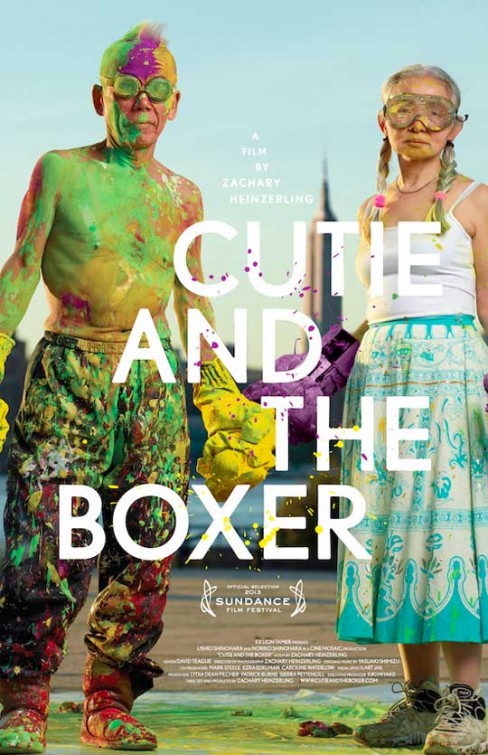
Film [Sundance 2013]: Cutie and the Boxer

How old do they look to you?
I have come to a stage in life where I sometimes forget how old I am. My age used to be a such a big deal to me. I'm still fairly young, but when I was even younger, hitting certain ages meant all kinds of new privileges, responsibilities, or milestones. Now every year is just less of an excuse for my immature behavior and a step closer to when my daughter will start calling me old. I find that when I think about my age I have to stop a second and recheck my calculations. I'm pretty good at head math and remembering numbers but I find this one doesn't quite stick.

As I mentioned in my last post I had an opportunity to attend the 2013 Sundance Film Festival and see Cutie and the Boxer, a documentary film by Zachary Heinzerling about Ushio and Noriko Shinohara, an aging Japanese married couple - both artists - living in New York City. As I've reflected on the film one of the most prominent thoughts that surfaces is age.

Age is perhaps our most defining physical characteristic. Maybe even more than race. And just like race and ethnicity, the physical cues that point to age can be misleading. It's easy to judge someone based on how old we think they are. We look at someone and we can make a guess. But while age is a reflection of the experiences gained through years lived and seen outwardly through the physical body, it's just a number. The identity of the person inside the body is not bound to any notion others have about how old they are. At any age we can be misjudged because of how old we look. As we get older some people define themselves less by their age and focus more on the way they feel. Maybe that's why I can't remember my age that well. That or I'm just getting older. In Cutie and the Boxer we see first an older couple, and then throughout the film we see more of who they really are and how they see themselves.

Zachary Heinzerling's documentary Cutie and the Boxer is not a film primarily about age, although it invokes thoughts about aging. It's a film about the relationship between a husband and a wife and the sacrifices it takes to dedicate your life to someone else. Back when they first met, Ushio was already a prominent avant garde artist, having made an impact in Japan and rubbing shoulders with people like Andy Warhol in New York. He was most famous for his boxing paintings. To create these pieces of art Ushio dresses himself up very much like a boxer, including strapping on boxing gloves with sponges dipped in paint. He then energetically punches a large canvas as he moves from right to left. The experience of creating these paintings, which takes only a couple of minutes, epitomizes who Ushio is and how he sees himself as an artist. He appreciates characteristics like power, energy, spontaneity, and movement. Also famous for his motorcycle and dinosaur sculptures, he likes to name his exhibits with words like "Vroom!!" and "Roaarrr!"
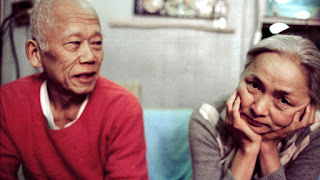
Ushio and Noriko Shinohara

According to her own story, Noriko was a young and eager artist fresh off the boat. She met Ushio, over 20 years her senior, and quickly entwined her life with his, giving up her own aspirations as an artist in the process. Jump forward after a child and 39 years of marriage and we them first as any other couple, with their quirks and recurring arguments. It seems the family focus has been on Ushio's career. We quickly realize that Noriko set a precedence very early on in their relationship by making significant sacrifices in her lifestyle to accomodate Ushio and his needs. Now, after four decades together, she's undergoing a retrospective of her life and breaking out as the artist she always meant to be. Ushio's career seems to be gaining new momentum as well.

The film follows from there, laying out small but defining interactions between Ushio and Noriko over a two-year period. Beautifully filmed and beautifully portrayed, it splices in principal photography, archive footage covering multiple periods of their life, and the fantastical world of each of their art - especially the animation of Cutie's world. The animation is based on Noriko's comic about Cutie and the Bullie, her caricatured interpretation of herself and Ushio. Much of their history is told through a creative process bringing her drawings to life. These vignettes fill out how these two amazing people arrived to become who they are now, but all from her perspective. Although the film is about both of them, she outshines as the main character.
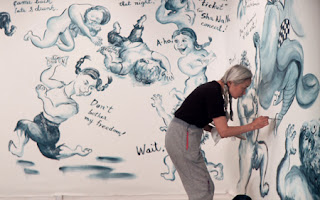
Creating Cutie

During the Q&A the director was asked why he decided to call the film Cutie and the Boxer when Noriko's comic named them Cutie and the Bullie. He answered that it just sounded better to him. I think the better answer - which he probably could've answered - is that it reflects the identity each of the characters would give themselves, even though neither is completely accurate. It's how they see their idealized selves. Noriko envisions herself as Cutie, the independent female artist able to overcome and tame her love-needy but headstrong husband. Ushio sees himself as the prize fighter and artistic genius of the family, his boxing paintings as a symbol of his power and art and therefore his dominance in their relationship. The reality of how each of these identities has manifested over the years is the result we see on the screen. Ushio surges ahead as the blind ambition in the family while Noriko quietly tweaks their trajectory, displaying the self awareness Ushio is incapable of conjuring.

Roarrr!!

It's true that at first glance the film can seem to portray Ushio as uncaring, prideful, and jealous. It's an example of one of those relationships where the woman, due to the man's negligence and denial, has to take over the practical functioning of the family. But Heinzerling also hinted at something that the movie subtly tells you as you watch: that Ushio is a good and dedicated man and that he and Noriko have come to an unspoken arrangement. Ushio has a vibrant and open personality and is honest, but his love is need-based. And, although she has struggled with it for their 40+ years together, Noriko is ok with that. She might even be willing to do it all again.

As a final note, the original score is a poignant, piano-based accompaniment that feels greater than itself. I couldn't help but compare it to music of Miyazaki's Studio Ghibli films (especially Spirited Away). Composed by Yasuaki Shimizu, it has a quiet introspective feel. (Check out Yasuaki's own saxophone interpretation of Bach's Cello Suite no. 1). Like in all the best movies, the score helps to drive home the emotional impact from the story on the screen. And it might even make you forget your age.