Sunday, January 27, 2013

Sundance Film Festival


There are a couple of things about me that make January a very special time of year: (1) I am a pretentious cinephile, and (2) I live in Utah. That's right! It means I have the opportunity to attend the Sundance Film Festival - an event that brings pretentious cinephiles from all over to the snowy slopes of Park City, UT, to watch independent films and make ourselves feel like we are smarter than everybody else. (spoiler alert: we're not). Robert Redford gave us all a place to gather and nerd out together.

I had the great joy of attending this year's Sundance festival - my review will be coming very soon. This was my second year attending. Both years I've only had the time and means to attend one film and so, obviously, I had to make my choice count. Last year my intuition told me to go see Beasts of the Southern Wild which took the festival by storm, winning the top awards. It was quickly picked up by a distributor, had a run through the rest of the year at the top festivals, made it into theaters across the country, and now is up for four oscars for Best Picture, Actress, Director, and Writing. I loved it. I had the opportunity to see the film at only its second public screening ever and enjoyed the Q&A with the cast and crew following the film. Most impressive was the performance of Quvenzhané Wallis, who plays the young girl, Hushpuppy, at the center of the film. She enjoys the distinction of the being the youngest person ever to be nominated as Best Actress. She's now nine years old and played the role at the age of five.


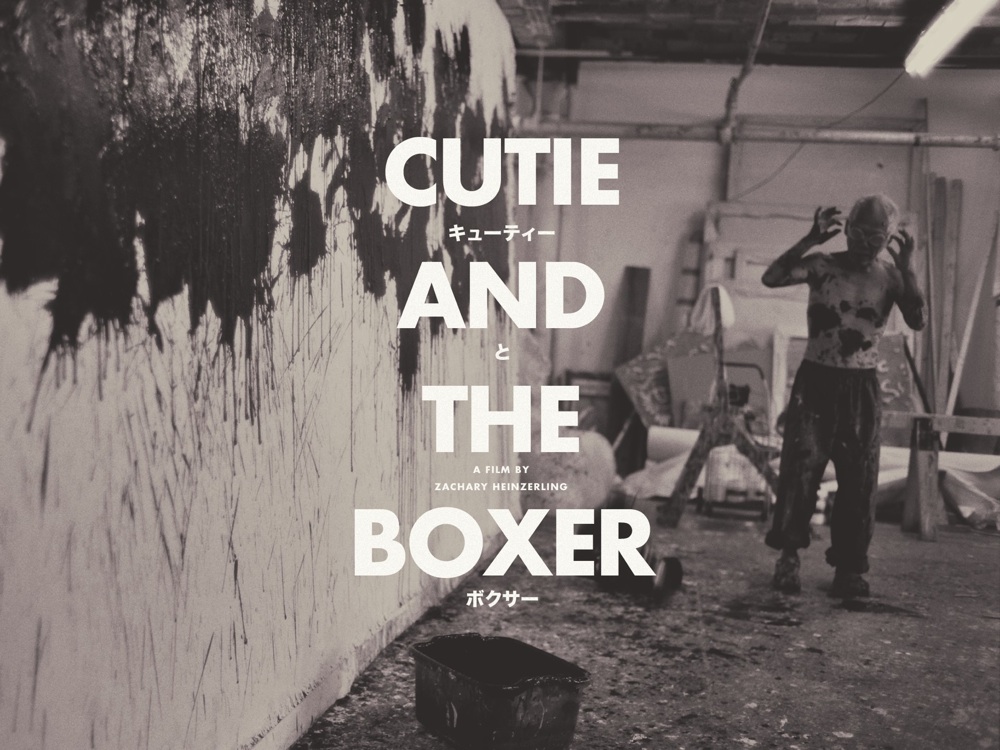
So naturally after that experience I'm sure you suspect I have prophetic abilities. That's not a responsibility I'm likely to accept - but I'll thank you for admitting merely that I have good taste. My pick for this year, the documentary Cutie and the Boxer, was awarded Best Direction in its category for the work of Zachary Heinzerling. (See my review here)


The interesting thing about Sundance is the number of films each year that make it to a wide release, either in theaters or through other avenues. Redbox, for example, usually has a number of independent films you can find that give you a better option than the usual offerings of the latest blockbusters, low quality action and horror flicks, and a string of straight to video releases. Some of the independent films I've spotted at Redboxes in my area over the past year include Another Earth, Safety Not Guaranteed, Sound of My Voice, and many others. You can find Beasts of the Southern Wild there right now. Do yourself a favor next time you head over to that crimson container and let your finger pass over The Expendables 2 and Step Up: Revolution and try on something a little more unique.

Brit Marling is a darling of Sundance. She seems to have a new movie to premiere every year.

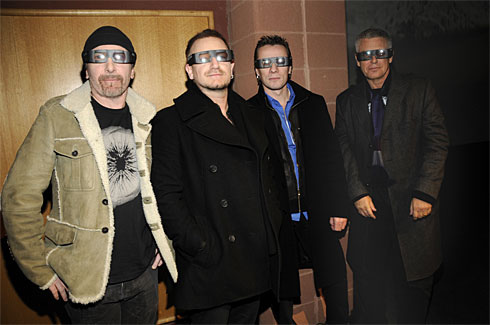
As I reflect on the festival I can't help but think of my biggest Sundance regret. I am a humongous U2 fan - not that my actual person is large, I'm more regular-sized. I just really love U2 and their music. My favorite group made cinematic history when they premiered their 3D concert film U23D at the Sundance Festival back in 2008. I'd heard about the movie and knew it was going to be at Sundance. I just didn't make the connection that the premiere - which the entire band attended - was happening less than an hour from where I lived and that I could potentially go. Luckily I had the chance to see it in all its IMAX 3D glory on the night I proposed to my now lovely wife - and by "now lovely wife" I mean she is now my wife when before she was not. She's always been lovely.

I could've gone to a movie with Bono

Monday, January 7, 2013

Film: Bill Cunningham New York

I don't imagine people really associate me with fashion. I aspire to look respectable and thanks to my three fashionable sisters and my mother I have some vague instincts about fashion which seem to serve me well enough, but I couldn't articulate why. At age 83, Bill Cunningham, a street fashion photographer based in New York, has had a sense of fashion all his life. After watching the truly delightful documentary film about him, Bill Cunningham New York, what I really aspire to do, more than be fashionable, is to love life as much as Bill Cunningham loves it.

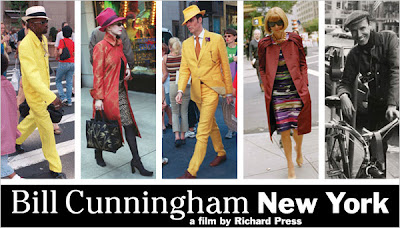
Although he has a sense of fashion, you wouldn't know it by looking at him. Usually he's seen on the streets of New York with a plain blue jacket he buys two or three at a time for $5 a piece, a pair of plain khaki-colored pants, and comfortable black shoes, with a camera hanging from his neck and a cheap bike in tow (he's had dozens stolen through the years while about his business). Bill Cunningham is known for capturing cutting edge fashion as caught by his camera's eye (he still uses film and won't switch to digital) on the streets of New York. He authors two weekly fashion columns for the New York Times. He's a legend in the New York fashion scene, and therefore across the world. Rather than wearing it himself, though, he's known for finding and displaying the trends on the street, never regarding the station of the wearer, and often focusing on the clothes completely, cutting out everything but the most interesting piece he finds. He loves the eccentric and the new. Indeed, he never judges others and seems to find the most uniquely dressed people in the city. And he has fun. All the time.
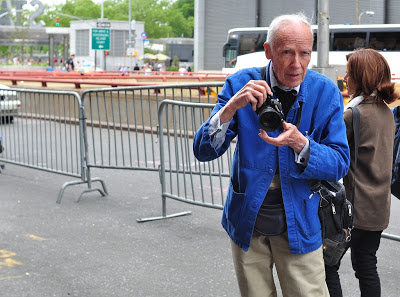

But I wouldn't be telling you all of this because of the clothes. The reason I get interested in Bill's view on clothes is because of the love he exudes for his job and the sheer dedication and focus he has on this one thing. Taking pictures is all he does all day, every day. And he scoffs at the idea of doing anything else. Bill Cunningham New York is by far my favorite documentary, and its because the way the filmmaker, Richard Press, highlights the joy of someone completely dedicated to his work - including its rewards and its costs - that you want to keep watching. Bill Cunningham is the type of guy who might say his work is never finished. He feels the immediacy of his routine and by watching him you might wish you could try on his shoes as he attacks life with energy and fervor. In part, this is because of the benefits you see from his dedication.


Through obsessively flinging himself into his work, which he enjoys without end, Bill has been able to successfully avail himself of those carnal desires that so many of us find so difficult to recuse ourselves of, either through excess or desire: wealth, food, and sex. He doesn't care about money. Decades ago when he sold his magazine, Details, he was hounded by the purchaser for weeks afterwards to cash his check from the sale. He says when you take money then you lose freedom. He laughs, "Money is what's cheap. Freedom's more expensive." Although he spends most nights taking pictures at high society functions and charity balls in New York, he never partakes of the free gourmet food. Never married, when asked if he has ever had a romantic relationship he replies, "It just would never occur to me to think of it." He bypasses these things with seeming effortlessness. It does seem, however, that in avoiding those desires he may also have missed out on a few of life's most rewarding experiences. Later, when he opens up, you wonder if he is thinking the same thing.

His home for decades was an apartment at Carnegie Hall filled to capacity with nothing but file cabinets documenting decades of photographs. He, along with the other artist residents, were forced to relocate.
Still, it is tempting to follow his format when you see all the things in life he avoids, crossing himself in everything else except for his work. He is a lean, mean, fashion-finding machine. But don't think his love for fashion is about fame or stature or acclaim. He's had opportunity for all those things and waved them aside without a second thought, just so he could get one more good shot. He's on speaking terms with the editor-in-chief of Vogue and international ambassadors, but seems to regard them the same as anyone else. We get an outside perspective on Bill from a cast of Bill's admirers, from industry experts to subjects of his photography; from neighbors to colleagues. You might say, if this were a different type of film, that it seems a bit one-sided, but the closest to negative feelings towards Bill I think anyone could have might be indifference.

Shail Upadhya, Diplomat from Nepal and a regular subject of Bill
One high point in the movie comes when, after much persuasion by friends and colleagues, he reluctantly accepts a lifetime achievement award in France. This a prestigious occasion. But he's in his same-old blue jacket accepting a medal from a worldwide leader in fashion during Fashion Week in Paris. True to form, in his acceptance speech he spouts pure gratitude and humility. He says its not about the celebrity or the spectacle. It's about the clothes. He says, "It's as true today as it ever was..." And then, in one of only two parts in the film where he really opens up on a deeper emotional level, his voice cracks as he says, "He who seeks beauty will find it." And in that moment you know he means it and truly seeks after it as much as you do for whatever it is that you find most true in life. And you really love him for it.

The other time is when he's asked about religion. A Catholic by upbringing, he still attends church every Sunday. He briefly mentions his family, saying they were simple and that although they didn't really understand his penchant for hats, they were good people. He still holds to what they taught him. His attendance at weekly mass is perhaps his only break from work in life besides sleeping. After getting choked up and hesitating for half a minute he says, "I think its a good thing." His responses to this question and others about his military service (he thinks its a duty and was proud to do it), love (he wouldn't have thought of it), and money (no need for it), all point to a practical man with traditional values that has a set of principles but would shy away from ever imposing those on others. He does what works for him. And after watching, you're a bit more dedicated in finding what works for yourself.


Wednesday, January 2, 2013

Books I read in 2012

Because I knew you cared, here's what I read in 2012, give or take. This may not be exhaustive. It is more or less listed chronologically, with some pithy and intelligent comments:

  1. Team of Rivals - Doris Kearns Goodwin
    • I picked it out awhile back in preparation for reading Abraham Lincoln Vampire Slayer. Now I'm a Lincoln fan and the vampires can slay themselves. Spielberg's Lincoln, which I am dying to see, is based on this. My very humble review.
  2. Pathfinder - Orson Scott Card
    • I love Orson Scott Card's books but recently they haven't been what they used to. While this is no Ender's Game, it is a much more intriguing and entertaining read than he's been producing lately. I mean, if you hate the movie Hook you're going to be hit and miss.
  3. Moneyball - Michael Lewis
    • While I don't follow baseball at all, I was intrigued by the movie and so borrowed the book. Moneyball was engaging because the odds were actually in Billy Beane's favor but a whole industry didn't want them to be. Like a case study from Freakonomics.
  4. The Hunger Games* - Suzanne Collins
    • It was better the first time. I wanted to fill in the parts I was missing when I watched the movie and found out that the plot and ideas are great, but Suzanne Collins' writing is not. *Previously read
  5. Leadership & Self-Deception: Getting Out of the Box - Arbinger Institute
  6. Asking: A 50-Minute Guide to Everything Board Members, Volunteers, and Staff Must Know - Jerold Paras
  7. The BFG - Roald Dahl
  8. My Antonia - Willa Cather
    • A pleasurable surprise. It follows Bohemian immigrants (actually from the region Bohemia, not incense burning artsy types) in Nebraska in the late nineteenth and early twentieth centuries. A lovely book.
  9. The Graveyard Book - Neil Gaiman
    • Nobody Owens, a baby orphan, is raised by ghosts in a graveyard. Sort of like Harry Potter all in one book. Very clever. Could also be described as "delightful," but I don't use that word.
  10. To The Rescue - Heidi Swinton
    • Sizeable but manageable biography of Thomas S Monson, President of the Church of Jesus Christ of Latterday Saints. Along with the expected, it contains some interesting insights on correlation. Points if you know what that means.
  11. Anna Karenina - Leo Tolstoy
    • Did I really not write a blog about this? I really meant to because it was the best book I read this year. Although I don't really know how much translation affect this, I love Tolstoy's style, purpose and description. I have so much to say about this one. The most unique might be that it is the biggest mis-title in literary history. I guess I'll have to write a review to explain.
  12. Frankenstein - Mary Shelley
    • My halloween read. Not that I usually have a Halloween read. All I can say is the book is vague on the description of Frankenstein's monster and so the bolts in the neck could maybe pass, but where did Hollywood pull Igor from?
  13. A Christmas Carol - Charles Dickens
    • Pretty much just like all the movies and tv shows have lead you to believe. A handful of new sections that I've never seen portrayed, including Spirit of Christmas Future showing Scrooge a married couple reluctantly grateful for his death... any creditor has to be better than him.
  14. The Prince - Niccolo Machiavelli
  15. The Children of Men - P.D. James
    • Great British writer. I've read a mystery by her and this was just as intriguing. A thoughtful and exciting exploration on what would happen if all of a sudden the human race became infertile.