Showing posts with label Movies. Show all posts

Tuesday, September 30, 2025

Riding the waves of Paul Thomas Anderson's One Battle After Another

One of the things about a Paul Thomas Anderson film is that there are often different levels operating at the same time. There might be a lot of motion on the screen as one character is harried, moving quickly through the set from one room to another, emotionally in chaos. At the same time another character, also in motion and interacting with the first, is calm and focused, operating on a different plane. You can feel the rhythm of both and the harmony where they interact in the same world. The ability of the film to communicate both so expertly at the same time reflects a level of mindfulness that is both exciting and grounding.

This dynamic is on display in One Battle After Another in a sequence where Leonardo DiCaprio’s character scrambles from room to room as he frantically searches for a place to charge his antique cell phone. His guide is Benicio Del Toro, known around town as the sensei for the local martial arts gym, who knows exactly what to do to extract himself, DiCaprio, and a bevy of illegal immigrants he is housing from his safehouse, where the authorities are currently knocking down the door. “Ocean waves… ocean waves,” he says calmly as he holds DiCaprio by the shoulders, then tells him, “Courage Bob,” with confidence.

DiCaprio is trying to reconnect with his daughter, Willa, played by the young talent Chase Infinit to get both of them safe from the grasp of Colonel Lockjaw, a corrupt cop chasing them down in an attempt to cover the tracks of their shared past. DiCaprio’s Bob has settled into a haze of smoke and domesticity, a contrast to his left-wing revolutionary roots. He was the explosives expert 16 years earlier, but now his pot-addled brain can’t recall the codes he needs to get in touch with his former comrades. DiCaprio is truly dedicated to being a bumbling but driven father, and the imbalance between the different sides of his character inspires much of the film’s humor.

But I go back to those interwoven layers working together to create the fabric of the experience. There is great writing behind the story, and equally important is the craftsmanship across all the filmmaking elements. The pairing of the cinematography and the music is especially key to what draws me in, and I find it moving in ways I often cannot explain. The music can often be a constant distorted, unsettling rhythm, or a more steady, orchestral sustained chord, as during the aforementioned extraction scene. At other times the camera is steady and calm, while the energy of the characters is communicated through the pairing of music and performance.

The composer Jonny Greenwood’s partnership with PTA continues in One Battle After Another, and it's hard to overstate its effectiveness. The composition process starts from the script, so rather than an afterthought, it is incorporated in the process from the start. The collaboration between director, composer, and production departments reflects true harmony, both in the music Greenwood writes and in how it integrates with the film.

There are some great moments where unique filmmaking solutions serve multiple purposes and result in brilliance. An example is how the rise and fall of desert roads are used to portray the advance of three characters engaged in a car chase scene. The up and down is like a roller coaster or, as was pointed out to me, like the crests and valleys of waves on the sea. In addition to being visually satisfying (especially on an IMAX screen), it sets up a way to show one character’s ability to adapt to new circumstances and brings the chase to an exciting and emotional climax.

Although I would not say the film’s purpose is outright political messaging, it is very satirical as it tackles real issues. There’s no doubt it has some regard for the revolutionaries and their self-declared fight for truth and freedom even as it critiques them. Themes covered include immigration, law enforcement, civil unrest, corruption, and what some will call vigilantism (others, domestic terrorism). It reminded me that we live in a country founded by revolutionaries. It certainly shows how they can go too far, though. It does not treat them with over-reverence, and there are jabs and caricatures of all extreme parties and its humor is often biting.

But if you have to distill this epic down to one thing, it’s the relationship between a father and a daughter. Bob and Willa, each so different, are a family unit that rely on each other, and that’s universally felt. The film is a case against extremism and a call for passionate support of others, in caring for those you love. It shows that sticking by those you care for can be a wild ride.


Thursday, October 29, 2020

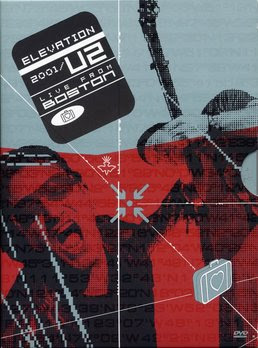
U2: Elevation 2001 - Live From Boston

Cover of U2 live in Boston
You probably remember your first-ever live concert. You felt the thrill of being a part of the crowd and the excitement of seeing the artist take the stage. Perhaps you found a greater appreciation for a certain member of the band and realized that in a live setting, songs you’d heard only in their recorded versions came alive in a new way. You may remember feeling the high, jumping up and down with excitement, and then just basking in the afterglow as the last song ended and you came back down to reality.

Hopefully you had an experience like that the first time you saw U2. That’s the way it was for me. It was when I watched U2. Live in Boston. The Elevation Tour DVD.

Ok, ok, hear me out. Let me give you some context. I grew up mostly in a little town in northeastern Montana during the early days of the internet era. I happened upon U2 through a series of random events that could only be orchestrated by Fate, and obtained The Joshua Tree CD when I was 11. I started to collect the band’s albums whenever and however I could. Again, it was long before iPods. Also, my only job was mowing my grandpa’s lawn.

I was 15 when All That You Can’t Leave Behind came out and it was the first album release I experienced in real time. I remember waiting SO LONG for music videos to load on U2.com over our dial-up modem. All I really knew about the band at this point was picked up by poring over liner notes and listening to their music incessantly on my Discman. Now they were the big thing of the moment, “Beautiful Day” was a hit, and they were all over TV. They were even going on tour! I was several days of driving away from anywhere they were headed and I didn’t even consider attending a show a possibility. Not happening.

Fast forward to early 2002. Always a music nerd, I was on a band trip in Billings, MT, and so we stopped at a mall for a few hours of shopping. This was like a visit to a pop culture oasis, and I was thirsty. I hightailed it to Sam Goody to look for music. As always, I went straight to the “U” section, and that’s when I saw it: the special edition DVD box set for The Elevation Tour: Live In Boston. Like a movie of U2? Where they’re recorded playing live? A whole concert? I paid the $32.99 without a thought – not a little sum to me in those days.

When I got home a day or two later, at the first chance I got I rushed down to our basement and put in the disc with the concert. I was tingling with anticipation and all alone with a front row ticket. From the first moments I was in a trance. I remember the slow-motion walk as the band enters the arena to the intro of “Elevation” with the house lights up. They start playing until, BOOM, the lights go out and they hit it hard. “Elevation” wasn’t my favorite song on ATYCLB but at this point I was all alone, in my basement, lights off, watching this amazing moment and FREAKING OUT.

One thing I learned while watching the show was that The Edge is the engine that keeps this band running. His guitar solos in “Until The End Of The World” and “Bullet The Blue Sky.” His angry guitar-slamming at the end of “Gone.” His beautiful smooth crooning on “In A Little While” – be still my heart. I could never have fully realized how much work The Edge does for the band until I saw him live. He became my hero.

There were many classic U2 moments that were completely new to me and I experienced for the first time: the bullfight between Bono & The Edge in “UTEOTW”; Larry’s snare drumming in “Sunday Bloody Sunday”; the crowd singing the end of “40”; the unforgettable climax of “Streets”; Bono singing intimately to the entire arena through one girl brought up on stage in “With or Without You”; and on and on.

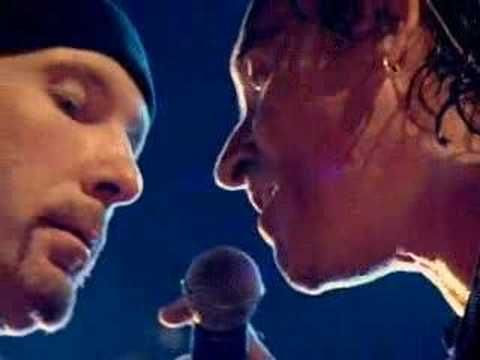
Bono & The Edge close-up singing

I had underestimated or previously failed to notice many of the songs they played, and seeing them performed in this context brought fresh perspective. “UTEOTW,” “Gone,” “I Will Follow,” “Stay,” and “The Fly” were all in that category. I went back to the records and heard these songs with new ears. And the combination of “Bad” in to “Where the Streets Have No Name” at the show’s zenith is almost indescribable. These were already some of my favorite U2 songs, but before this I hadn’t realized their full potential: two of the band’s most soaring anthems coming together in a blissful explosion. I know some say “City of Blinding Lights” is the new “Streets,” but there is nothing that compares for me.

I also knew ATYCLB really well, so “Beautiful Day,” “Kite,” and “New York” felt exciting. But it was “Stuck in a Moment You Can’t Get Out Of” and “In A Little While” that had me, at first, up out of my chair with excitement, and, at their conclusion, each leaving me in a puddle on the floor. And “Walk On” was a perfect closer. I was almost in tears as Bono sang out his declarations of gratitude. As the last notes approached and the credits started to roll, I just sat there dumbfounded, paralyzed, basking in the experience.

I know I wasn’t at a live concert, but there are few moments in my U2 fandom as visceral and exciting as watching this amazing concert film. It transformed my understanding of the band. As a student of the visual medium, the story told through the editing was energetic and put me in all the right places of the arena at all the right times. In addition to the music, I also loved hearing Bono tell stories and seeing how the four band members interacted with each other in a hundred small moments. I felt like I really got to know them and was blown away by how they connected with the audience.

Since then, I have seen the band six times live. The first time was the 360° tour in Chicago. Even though I was way up in the cheap seats, it was a thrill with many impactful moments. Still, I can remember Live in Boston more than I remember moments from that tour. The next time I saw them on the GA floor at Innocence and Experience, just a few feet from the front bar, was when I finally had the truly rapturous live, in-person experience. The Joshua Tree 2017 and Experience and Innocence tours both provided some amazing memories as well. But I will always remember fondly the Sunday afternoon that this nerdy, small-town teenager really got a taste of seeing U2 live. I’m excited for all of those who will get to see U2 live in some really amazing places starting next month on the Joshua Tree tour 2019.

Tuesday, June 23, 2020

Inside Llewyn Davis

Inside Llewyn Davis - Alternative Movie Poster by Ignacio
Poster by Ignacio RC
Inside Llewyn Davis tells the story of a down-on-his-luck, ne'er-do-well folk musician, Llewyn Davis (played by Oscar Isaac) in Greenwich Village in New York City in 1961. Quickly you get to know his routine: play music, scrounge to make a living, sleep on friend's couches, and all with a bad attitude. But maybe this isn't how he always was. He was part of a duo, and you get the feeling Llewyn Davis was the less-personable half of the act. His partner's gone, from the band and from this world. Llewyn is still in mourning. Late in the film a music promoter tells him he's no good as a frontman or a solo act, "My advice: get back together." "That's great advice," Llewyn answers.

This film is not one of redemption or hope, though those things are there. It's a story of struggling and survival. But just surviving is not what Llewyn Davis is interested in. When stopping by his sister's place - in her decidedly non-Bohemian little suburb home, she suggests he quit music, which he seems to be failing at, and go back to being a sailor, like their father. "And what, just exist?" he asks. And so he tells us, music is what gives life its flavor, like the starving poet who doesn't take a real job so that he can experience suffering, thereby enriching his poetry, but always hoping for a hit to make it big.

And music is where the flavor of Inside Llewyn Davis lies. It's what keeps you watching and hoping for a main character that is kind of a jerk to everyone around him and knows it. The songs here, performed by Isaac, Marcus Mumford of Mumford & Sons (singing the part of the deceased partner, Mike), Justin Timberlake, and a host of others, all overseen by the legendary T Bone Burnett, are, of course, the heart of the movie. The famous Gaslight Cafe figures prominently, with its smoking patrons listening to everything from young buskers with guitars to grandmothers from Oklahoma with their autoharps. And when Llewyn Davis is playing songs, that's when you see his heart right out there. Great music can make life bearable where otherwise it seems impossible to endure.

And that partly explains Llewyn's bad mood: his music is who he is, and it is rejected, at least at the level of being able to provide for himself. The world doesn't seem to have a place for him in music besides a loaned couch for a couple of days. He and his partner had a record which didn't sell. Llewyn has his own solo record, which hasn't sold. He meets another hopeful young folk singer, Al Cody (played by Adam Driver) at a recording session. While crashing on Cody's couch, Llewyn goes to stuff his unbought records under the end table, only to find a similar box with dozens of copies of Cody's own unsold solo album. He sees his future and his past. Llewyn writes it off as "careerist" when a pair of friends, another musician (Justin Timberlake) and his wife (Carey Mulligan) aspire to use music to settle down with a home and a family. Llewyn Davis, you see, is a pure artist. All the way down to living in the gutter.

And that brings us to his personal life and the damage he's caused. He's got a regular relationship with a doctor that will perform abortions, including one for his friend's girl. He may have a kid in Akron, Ohio, and his relationship with his dad is... strained. Llewyn doesn't really connect with others except through his music, and even when he considers giving that up, he can't find a way out.

And then there's the cat(s). The cat is like a cipher for the film. Is it his lost partner? Himself, always wanting to get out, even from a comfortable situation? Lost, mistaken, and left for dead? Does he have 9 lives? Is it a living burden that he can't just seem to let go of? His eventual redemption? It could stand for a lot of things but may not stand for any of them.

Currently available on Amazon Prime. Rated R for language.

Thursday, May 7, 2020

This Is Not A Film

Jafar Panahi, the Iranian director, is a guy who can't stop making films. He's been finding ways to create them while under house arrest in Iran after his last film was not approved since around 2010. And so he finds a way to make it happen, to reflect on film and what it means to him. This Is Not A Film (2011) follows him through a day in his home discussing his appeal case and hanging out with another filmmaker, reflecting on the situation he's in. It was filmed entirely in his home and, the legend has it, smuggled out in a cake before eventually being submitted to the Cannes Film Festival.

I'll be honest, I haven't seen any of his pre-ban films, though I have them on my criterion channel watchlist. The story behind his recent films is just so compelling that they are what drew me in. Taxi (2015) was the first I saw and it follows him driving a taxi around Tehran in a period when he's allowed out of his house but still banned from officially making movies or leaving a country. This is what man trying to be honest can do from within his own home. I think this one actually makes a great double feature with Jim Jarmusch's Paterson, as they both are very meditative reflections of art through the story of one man's simple day-to-day experience.

There's something so beautiful that slowly builds here, as we observe Panahi and how he speaks about life through the language of film. Early on he decides to try and describe last film he couldn't make as he would've made it. After painting the opening scene he stops, coming to the realization that "You have to make the film first, to be able to describe it." The film is not the plan of the film but the end result of the alchemy, struggle. and spontaneity that comes out of the process. He turns to scenes from previous films he's made to describe examples, and we watch these, though only as captured by the camera filming his TV screen, and they becomes reveries or like dream sequences within this film.

Visually, at first you just notice the lack of any real cinematography. He has a handheld camera and an iphone. After we as the audience become accustomed to this as a baseline, we realize he is able to capture some beautifully spontaneous angles and moments. These may not be objectively cinematic, but they become so through the context, both of what we are given in the film and through the situation Panahi is in and what we can sense of his feelings.

It makes strong and subversive statements, while balancing both acceptance and frustration at the same time. He doesn't comment directly on the government at any point - that would be bound to get him in more trouble - but he lets it speak for itself. It is New Year's night and the city is alive with light and sound for Fireworks Wednesday, a cultural tradition we learn is condemned by leadership as unreligious from the newscasts we pick up on the TV. Panahi surfs the internet to find some basic information and every page is either highly censored or completely blocked. Daily life of comings and goings is relatable as it is for most humans -- he feeds his pet, he makes tea, friends and neighbors come and ask for this or that -- but there are these cracks that help to outline the greater freedoms that exist in many other places throughout the world.

Tuesday, April 28, 2020

A Man For All Seasons

I found this 1967 Best Picture winner a stirring film. It is a costume drama set in 16th century England that is very serious indeed. But it is not stuffy even as it is in earnest. It is about something we all aspire to be: a person being true to himself and what he believes. It is inspiring to see a man hold firm to his principles in a world where so many are saying “Why? What does it matter? It’s just a little oath.” But he will not. In this day and age I find it extremely refreshing.

We see our main subject, Sir Thomas Moore, at the start of the film receiving a royal notice from among the highest of offices in the country. The cardinal of England sends a message which we follow to Moore's estate. Moore has a vibrant household, his own court, a loving wife and doting daughter, a great house and servants. He is a man of means and influence and is also a man of great faith. He gathers his wife and daughter for prayer before he heeds the call to the cardinal to discuss the future of England.

There is a supplicating young man, Sir Rich, anxious to serve in his court but Moore sees him as too eager and offers him the advice to become a teacher instead. He warns him to turn away from the pursuit of money, notoriety, and influence. Rich (aptly named) is confused at this advice. Later when confronted with the choice to work for Moore's rival, a corrupt clerk of the church, he almost follows this advice. but bitterness gets the best of him, and the attraction of power and money. Rich threatens his lack of loyalty. Moore knew this all along and turns him away despite the threat.

The setup is this: King Hentry VIII is married to Catherine, his brother's widow, who is barren and therefore there is no heir to the dynasty. Henry is having an affair with Anne Bolyn and wants to divorce his wife to marry her, which is against the teachings of the church. Having already gotten special dispensation from the pope to marry Catherine, Henry needs someone like Thomas, a trusted and faithful believer, to stand on his side in seeking the divorce. Moore, always careful never to declare any statement against the king and the proposition, will not provide his support, even when the king names him Chancellor to England specifically for that purpose.

Moore is one of those guys that you say you want when you would prefer a leader who doesn’t want to lead. He warns against power, bribery, and corruption. He is careful with is tongue, always speaking facts and letting others come to their own conclusions. He is loved and trusted. He is the one man the king seeks approval from and the one man in the country who will not give it. Even when an oath is required to support King Henry as head of the new Church of England, at risk of being named a traitor.

Visually, the film puts Thomas Moore and his old friend Rich on inverse paths. As Thomas's position is lessened which each new appeal that he acquiesce, his home becomes threadbare, servantless, and then he winds up in prison, each cell getting more dark and dank. And he is anxious for his family, but at peace with himself. On the contrary, each time we see Rich he has a nicer coat and a bit more power, and is always looking nervously over his shoulder for the next command from the clerk to find something to sully Moore's name to the public.

The great climax is just like Peter testifying before Rome when Moore is brought before a trial at the highest court of the land. He performs admirably - he was trained as a lawyer, after all - defending himself against the baseless accusations. He declares that Truth is not changed by the vote of the people or the decree of a king. Rich is brought in and we see the contrast between two men - one who held his word and his faith as a part himself, and the other that let it go at every offer.

Wednesday, April 1, 2020

Malcom X

As I started watching Spike Lee’s 1992 biographical film Malcolm X on TCM this week I recalled that I once wrote a paper on Malcom X at a fairly young age in school—could’ve been elementary school, could’ve been middle school. The only thing I remembered was that I did the paper and little else besides that he was a civil rights thought leader and that the general impression I got was that he was a bit militant. In this case my ignorance made the film more compelling as Lee’s film quickly pulled me in and blew away any expectations I had.

The key to this film, for me, was the intensity in which Malcolm approaches each period of his life. Starting as a cocksure criminal, to his full-bore prison humbling and conversion, to his staunch and righteous leadership among his Muslim brotherhood, it is in the final stage of his life that the intensity starts to settle and transform to acceptance, openness, and humility. Each stage portrayed is built on a foundation carefully laid by Lee and his co-writer Arnold Perl. It provides the audience an understanding of Malcom’s character development, showcasing his strengths but not shying away from his blindspots.

Even knowing a few overarching details about his life, each change in his character, including and especially how he started his adulthood as a hustler, is a surprise. In each era of his journey he runs up against a wall and is willing to completely throw away his old self in order to adapt a system that makes more sense than the last. In the first, his street life is a reaction to the trauma of his younger years. He learns to just focus on himself. He is skilled and can get lots of women, alcohol, and drugs. Then in prison he abandons that by adapting a worldview that tells him how the world has been conspiring against him and his brothers who he must build up through the teachings of a great and admirable man. Finally, he sees the flaw in following man at all, and for abandoning that for a higher center of focus, he is rejected by his own people and slain.

It’s powerfully told with some stylistic flares from early-90’s Spike Lee that bring you to the edge of your seat where other biographical epics of this scale would induce a yawn. These include low-angled, tilted ultra close-ups; vibrant long-shots highlighting Harlem and other settings; remix of archival footage; the opening intro and closing coda; and flashes of visceral, mind’s eye, psychological imagery, not to mention time period juxtaposition, like the flashback shot of him and his father both with their guns in hand protecting their families and fleeing their burning homes. At the same time, Lee also gets all the majestic, grandstanding, autobiographical mainstays just right, i.e. rousing speeches, dramatic touch points, and accompanying symphonic score. The shifts in tone are at times fluid, at times abrupt, but never off-key.

I think the most beautiful sequence is Malcom’s pilgrimage to Mecca and subsequent evolution. To see this great man continue to grow and evolve into a constantly better version of himself is an inspiring example. There were views expressed through the film which I couldn't reconcile with my own thoughts and what the film itself seemed to be saying and I was drawn to keep watching to try and understand. They often made sense from Malcom’s life experience at the time but many were controversial even to other African Americans. But the film didn’t shy away from these, nor did it really denounce any, and this brought his character into clearer view by the end of his life. As he dies he is still a man in a point of transition.

Regarding the acting, Denzel is one of our greatest actors of our time and here proves that over and over again. In so many roles, he plies the audience with a charm that can turn on a dime from being endearing and playful to powerfully striking and serious. You lose him in the character more and more as the film progresses. Looking back at the Oscars for 1993, although I haven't seen all the performances nominated for best actor, his is one of two still considered today and certainly the most remembered. It seems a mistake in hindsight to not have given the statue to him.

The last thing I’ll mention is the power of Angela Bassett and the portrayal of Betty & Malcom’s romance. She is powerful, sweet, and loyal. While they did take a couple of liberties in aspects of their home life, his widow served as a consultant on the film. You can feel the heat of their love, based in their love of God, and it is an anchor.

Although the film is quite long at three and a quarter hours, it is compelling and a rewarding watch. It's rated PG-13 for language and would be a great civics lesson for any teenager.

Friday, February 21, 2020

Little Women (2019)

What a beautifully crafted film. As the fifth big-screen adaptation of this classic story by Louisa May Alcott, Greta Gerwig's version, which she both wrote and directed, had quite a challenge before it. This story is a touchstone that each generation takes on as a beloved story, time and time again, each instance reflecting evolving values. I've never read the book and only seen the 1994 version with Winona Ryder. Gerwig's version is one that most definitely is representative of the values of 2019.

About 15 minutes into the film my wife leaned over to me and said, "This is already a better version of the story." She's a fan of the book that always disliked the ending. Alcott originally wrote it as a serial, as you may know, and so that ending was not planned from the beginning. Despite that, it was a cultural smash and bestseller, primarily for telling the side of the story that was never reflected in popular writing before, namely the passions and struggles of domestic life of girls and women.

Gerwig's innovation is splitting the telling of the story between the two time periods - childhood and adulthood - jumping back and forth between them while moving forward in each storyline. This has caused some small confusion for some, but just pay attention to the light: the childhood segments are all bathed in a warm, unmistakable golden glow, while the adult era is cold and blue. By using the time periods this way she reveals a key choice that our protagonist, Jo March, makes which normally isn't revealed until halfway through the story. Here, we know what happens and the key question becomes why. Rather than focus on what choice she's going to make and how it affects her marital status, this format asks, by the end of the film, who has she become.

Because it is about four sisters, the story is known for telling the struggle of women in this period of history, and that aspect is certainly prominent in this telling. Adult Amy's speech to Laurie in Paris points out that women are beholden to men, giving a direct description of how ownership of money and even children is prioritized for their husbands. The struggles the March women face is in large part due to not having a man in the house for much for their childhood while the father is off to war. Ever present is the opportunity that marriage plays in their search for meaning and prosperity. For many it is a trade-off between love and security. "Don't tell me marriage isn't an economic proposition," Amy assertively declares.

Deeper than the struggle of women, though, there is a question of seeking dignity that is even more universal. We all seek for meaning in our lives. And one thing I love so much about this telling of the story is that even though the choice that each March woman ends up making is different, they can find dignity and love in their respective situations. There is a wisdom in moving past what you had thought or assumed was what you wanted, especially when that option is taken away from you by someone else. You can learn to live with that and find even deeper and more fulfilling opportunities that you hadn't expected. This plays out in each storyline but is especially at the heart of Jo's.

The craft in filmmaking is strong here and Gerwig puts a powerful team together. Learning about how the Oscar winning Costume Designer used color and clothing to tell the story, assigning color to each sister and the trading of vests between Jo & Laurie, is revealing. The cinematography captures this era beautifully with just enough diversity of settings and angles to go beyond your traditional costume drama cliches. Instead it uses the setting and visuals to add emotional depth to the story. The visual poetry between the two time periods around a setting like the beach or a visual piece like a piano is used all over the film. Every actor adds something unique and tells a different side of this story of dignity.

And again to the writing. I think to bring such life and to rethink a classic in this way should've gotten Gerwig an Adapted Screenplay Oscar, as much as I loved Jojo Rabbit. Some lines you will hear and assume they were one of the modern additions, only to find that they were pulled directly from the book. Other lives you might think you remember reading that in the book but will find it was an addition by Gerwig or an improvisation by an actor.

Tuesday, January 14, 2020

The Best Years Of Our Lives

The Best Years Of Our Lives (1946) is one of the most lauded American films you've never heard of. It won Best Picture at the 1947 Oscars. It is on the AFI top 100 films list. It was the top box office film of its time since Gone With The Wind. It was a cultural smash but not one that's seen as much today.  Previously not on any streaming platform, it is a hard film to find and I was lucky to see it on the Criterion Channel and watch it this week. As one of the most realistic films from this era, it follows three veterans coming home from World War II to fictional Boone City. We meet them on their journey home where there is a shorthand that comes between people who have been through the same trying experiences. We follow them through their reintroduction into normal society. The film's gaze is steady with long takes lingering on the full experience of these soldiers and their family, showing us the unique nature of people trying to restart their lives amidst many complications and it is so relatable to today.

The first story follows Homer, a vet who lost both of his hands and is returning home to his promised girl and his family. He has hooks on the ends of both arms now and can adroitly use them for almost any task including lighting cigarettes and cleaning and shooting his gun. He has difficulty dealing with how others struggle to know how to act around him. He's played by a veteran that faced the same situation and who won two Oscars for this role. He's compelling in his emotional ups and downs as he manages his own expectations with those of others and can't seem to face opening up.


Another story follow Al, a wealthy banker returning to his wife, his adult daughter Peggy and his son. Peggy and her mother are great characters with patience to step in and roll with the punches of Al's awkwardness, even as some of his behavior, like his drinking, is a little troubling. Those actresses, Myrna Loy and Theresa Wright, give my two favorite performances here. They add a great dynamic on screen, communicating the reality of what the citizens at home went through and how they adapted during the war. Those that stayed home are very much a part of this story as they have to learn to adjust to their returning loved ones. Indeed, there are examples of both citizens and veterans in dealing with their struggles in positive and negative ways.


The final veteran is Fred Darry, whose family lives under the tracks in a poor part of town. His wife has moved into her own apartment and created a life working at a club and enjoying the nightlife. They barely knew each other before, having gotten married less than two weeks before he went off to war, and have to get reacquainted now. She doesn't understand why he doesn't want to wear his uniform out on the town and he seems oblivious to her many male acquaintances. Fred gets entangled with Peggy, Al's daughter. The instant connection and unrequited love between Peggy and Fred is one of the great loves on film. Their connection was immediate and electric and troubled by his existing marriage and their dedication to propriety.


The Best Years of Our Lives depicts the great classic American hometown while at the same time the real cracks in the pavement that the servicemen face when coming home to a world that may not be quite ready for them, and them for it. Whether its a moral conundrum at work, a penchant to resort to a drink when things are hard, self-doubt, PTSD (before it was a thing people knew about), being in over your head and facing complications in love, all of these characters are experiencing problems that still happen every day.

The solutions for these problems don't always work themselves out easily, and yet it is a film with a lot of hope. The biggest surprise of this film to me was how honest communication and openness are what lead to learning and growth in every case. As the characters avoid talking and addressing their problems they get worse but as they confront them in difficult conversations and circumstances, they are able to take steps forward. I loved the value it placed on turning to others and sharing your issues rather than hiding them. At the time this was a bit of a radical idea, and one that could've been really instrumental to people that were struggling with these issues and saw themselves in the characters on the screen. It certainly did some of that for me.

Monday, December 30, 2019

Peanut Butter Falcon

Peanut Butter Falcon is a great feel-good movie where two outcasts on-the-run see the best in each other and let that lift them up. Zak is a 22 year old man who defines himself by his downs syndrome. The state has put him in a nursing home where he's the youngest resident by 50 years. He breaks out and runs into Tyler (Shia LeBeouf), a ne'er do well blue collar worker who is trying to escape his own set of mistakes. When Zak tells his newfound friend of his disability, Tyler responds, without missing a beat, by saying "I don't give a s--t," in the tone of W.C. Fields quote "I am free of all prejudices. I hate everyone equally." He is equal parts unforgiving and accepting. Zak is not used to that response. He shares that he's hoping to travel to the wrestling school of the "Saltwater Redneck" a pro-wrestler he's obsessively idolized as his hero.

The film was created around actor Zack Gottsagen, who the filmmakers met through a camp they were participating in. It serves as a great dissertation on how to interact with someone who is disabled. We see many calling him a "retard" as well as those that are his advocates, this group focused on Eleanor (Dakota Johnson) a social worker from the nursing home that has befriended Zak and taken him as a special case. She's out looking for Zak hoping to track him down after his escape. She meets Tyler who tells her to stop calling him "retarded," too, pointing out that treating him as disabled is the same as telling him he is disabled. This is a paradigm shift for both Zak and Eleanor and one that they both seem to have needed to hear.

Tyler's got his own lessons to learn, as well. Upon introduction you wonder why he's so against the world and eventually learn of some of the baggage he's carrying. Zak provides an outlet to face and accept some of those things within himself. Perhaps this sounds a bit sappy, but it's told truthfully, and with a lot of humor. The amazing cast is rounded out with people like John Hawkes, Bruce Dern, and Thomas Haden Church along with a couple of professional wrestlers representing Zak Gottsagen's own interests.

Shia LeBeouf is real against Zack and that relationship makes this film shine. LeBeouf has been a bit of a punching bag in Hollywood since his rise to blockbuster stardom with the Transformer movies. As with so many child actors with huge success, he struggled with substance abuse and adjustment and then started to make a lot of very crazy-seeming choices. I've always been endeared to his more quirky decisions and find the "Do it" motivational video un-ironically inspiring every time I watch it. In his more recent performances he uses his reputation to his advantage. We all know he's a bit damaged and a bit lost and we feel that in his character here.

This is a buddy film and a road-trip flick and as such, Peanut Butter Falcon has the requisite soundtrack needed to be on part with the best of those genres. It's a film that feels like a labor of love. This is an example of a great independent film with a modest budget coming in with all the quality and heart you could want. I look forward to what co-directors Tyler Nilson and Michael Schwartz have for us next.

Friday, December 20, 2019

Star Wars Episode IX: The Rise of Skywalker

Star Wars The Rise of Skywalker Film Review
If there's one thing I can say definitively about The Rise of Skywalker, it is that I was entertained the entire time. I had a lot of fun. I mean, how do you end a saga of 9 films all out of order, with 5 directors, two studios, and all over 42 years? Expectations from fans, from studios, for the box office and for yourself to create something that you can put your stamp on and send out into the world. The pressure is on director JJ Abrams in such an intense way. There is no way to please everybody. I admit that throughout my viewing I was holding on to hope thinking, "I've enjoyed it this far... it's ok... oh they did that?! I can handle that. Whoa! now that's a choice...," and so on.

The experience of watching Rise is an exercise in battling reluctance. A reluctance, based in cynicism, to analyze, to call out as pandering, to avoid cliche. A reluctance to what? A reluctance to giving in and accepting where the story is taking you, where you know it is heading, and in deciding to go there with it and enjoy it.

I feel like the Great Debate to rage on for eternity will be, did Rian Johnson do a way better set up for Rise with his installment, The Last Jedi, than previously thought, or did JJ Abrams reverse everything Johnson did that was original just to pander to fans? After watching this my respect and appreciation for The Last Jedi (which I enjoyed, overall, for the record) grew quite a bit. How upset were people about Darth Vader's announcement in The Empire Strikes Back? Maybe a lot of people were upset on what it was suggesting before they had the last installment to iron it out. For all the merits of The Last Jedi, I had thought that it had missed the opportunity to be the perfect middle piece in a story arc. I feel like Rise shows me that where I thought they had taken a left turn, a fully-formed arc really does exist. I now fully see the light.*

And the core of story of Rey carries through from Episodes VII and VIII. In Rise her and Kylo Ren's struggle to turn each other to their respective sides of the force, and her questions and feelings about her origins, are all explored to their conclusion. At a key moment, Rey is presented with a choice without a clear solution. The ultimate question deciding the fate of the galaxy is given as a puzzle where it seems the only answer is to give in to evil. On one hand we know something must end but on the other, to end it would be giving in to that very evil. This is a wholly relatable choice for every one of us and is the question between reluctance and doubt or acceptance and letting go.

Beyond the story, this was a visual spectacle with the use of light in the frame perhaps the most artful  since The Empire Strikes Back. I can think of one frame that stands out: all black except for the sliver of Rey's face, white and gray in the right third of the frame, as she looks off, unsure of what's coming, but determined. It was striking. Some may say the strobe-like flash lighting (for which an epileptic warning is given prior to the film) is partly an effort to distract from the glossy-eyed, aged, and burned-looking face of Palpatine, whose role is reprised by Ian McDiarmid. It does serve to keep you from looking too closely at his make-up, another thing I was as reluctant to do as I was to accept him in this film. But still, the effect of the light was almost like alternating between a black and white photo and its negative, and kept you guessing as to what the next move was. It's a visual theme throughout. 

The colors and framing are rich and deep, unlike the flat, over-digitized cityscapes and vistas which, at times, kept the prequels feeling empty. Like all the Star Wars films, you are presented with lush world-building. This is at its best when it hints at other great stories on the outlines. Keri Russell's character Zorri, her unexplained backstory with Poe, and the settlement in the rocky, snow-globe-of-a-world she is introduced in are a great example of this. There are other interesting planets that are introduced along with new ways to interact with the galaxy and even to use the force. We're being stretched a bit, something Johnson prepared us for.

In the end, this gives you everything you expect, and a bit more. Some will be satisfied at getting just that, while others may find that limiting and perhaps even eyeroll-inducing. For your own sake, treat it like the force: just give in to it and let it flow through you.

*Though the whole Admiral Holdo storyline with not telling anyone the plan is still reprehensible and frustrating.


------Spoiler Talk Beyond-----


------ Seriously, Spoilers ahead ------


------ You were warned! ------


Random spoilerly thoughts:

I wanted the turning of Ben to happen but I wasn't sure it really ever would or how it would. I would've loved to sit with Ben Solo a little more. I felt reluctance about The kiss between him and Rey but it felt right in the moment, it was what I found I had hoped for. This is what I mean - a reluctance and then acceptance. Because, guess what? To not do it just because people feel like an ending where a guy and a girl kiss is what's expected, is the wrong reason. These two had a tension between them that was, if not wholly committed to as sexual tension, was deeply emotional and a need of release of some type was what anyone would feel in that moment.

The scenes with Leia on this first viewing were hard to watch without analyzing how much and to what extent they were able to mine from unused, or even used, footage from the previous two films. I noticed she said lines that were a bit vague, stood in basically one angle when seeing her actual face (and so coming from one scene, likely), and had a lot of silent looks rather than lines. But what else could they do? And really, in the end, it works and is a better ending to her story than just writing her out.

Luke's admitting he was wrong really puts TLJ into focus for me. Yoda basically indicated that in TLJ itself already so I have to realize Luke has an arc of his own that this brings to a close. We understand his choice to run away now because Rey felt exactly the same way when she saw what was happening in herself in the hunt for Palpatine.

A list of throwbacks that come to mind right now after having just left the theater:
  • Chewie gets his medal!
  • Luke as force ghost
  • Wedge Antilles in final battle
  • Do we see Lando and Nien Nunb in the same frame together?
  • Death Star II (I question the proportions of size, I would've guessed the eye of the space station was like the size of Rhode Island and so not walkable)
  • Han Solo in Ben's mind, no force ghost?
  • Sith Dagger that's basically the coin from Goonies - I laughed at that!
Bold choices that were made that you've just gotta accept:
  • Go all in on Sith v Jedi
  • Bring back Palpatine
  • Take us to a hidden Sith planet, Exega, with a Sith temple very much like the one in Rebels
  • Create an entire thousand-strong Star Destroyer fleet - each a death star unto itself - out of whole cloth?
  • Ret-con Leia and Luke's training (w/digital recreation) - also serving to make Leia's force float slightly less crazy

Friday, September 8, 2017

Logan Lucky

Within Logan Lucky the film itself gives you the most succinct description of what it is: Ocean's Seven-Eleven. Steven Soderbergh returns to the comedy heist genre replacing Las Vegas with West Virginia, the equivalent of a casino on boxing night being a big Nascar race at a track, and instead of a swanky pair of slick criminals we have a couple of lovable, white-trash brothers who you should not underestimate. While not as innovative and novel in style as his original foray into this type of movie, I'm glad Soderberg's back with Logan Lucky.

One of the things I think Lucky might have over Ocean's 11 are the main performances, though not by much. Clooney and Pitt are undeniable talents, and the ensemble of the Ocean's films made those instant classics. Here the key players really stand out, as well. I think a big part of it is the innocence Adam Driver and Channing Tatum bring respectively to the roles of Clyde and Jimmy Logan, a pair of brothers from a family everyone says is cursed. After losing his job Jimmy is fed up and frustrated as he tries to make ends meet enough to be able to spend time with his little daughter every other weekend, fearful that the influence of his ex-wife (Katie Holmes) and her wealthy husband are having on her. Apparently not surprised by his brother's ideas, Clyde settles in to hear Jimmy out on his hair-brained idea. They both use the southern accent to their benefit, drawing you into their welcoming, unassuming demeanor. They're teachable even as they have some secrets and tricks up their sleeve that, much like the Ocean's trilogy before, you don't get the full scope of until the end. While any heist movie certainly has to have some amazing set-pieces and a keen ability for misdirection, it is a good sign that you can enjoy the movie even if you don't fully understand what happens at the climax.


While certainly not an impeccable motion picture, Logan Lucky  packs a punch with its comedy. Tatum plays the straight man and while his little girl is sweet, Driver as Clyde is a relief with his dry sensitivity, and the prosthetic arm is used to full effect. At the end you may not wholly understand every aspect of the job but the laughs are what keep you interested in what is a surprisingly breezy 2 hours. A lot of fun characters fill out the gang but especially delightful is Daniel Craig as Joe Bang, along with his two less-than-bright younger siblings. The brothers require a moral justification before they can commit a crime, though any novice in the art of spin should be able to concoct a noble cause simple enough to get these guys on board. Riley Keough rounds out the main players as Tatum's & Driver's kid sister, on board to break the family's run of luck. On the villain side, Dwight Yoakam as a corruptible prison warden and Hillary Swank as a silently terrifying FBI agent both dig into their roles, obviously enjoying themselves.


Soderbergh has famously been in "retirement" from filmmaking. Really it was a hiatus and he has been very busy with other things like TV (The Knick) and any number of other projects which you can read about on his website. The funny thing is that it's only been four years since his last directorial feature, 2013's HBO film Behind The Candelabra. That's the normal lag-time between projects for many directors but Soderbergh has always been efficient and prolific. When he won his Oscar for Best Directing for Traffic he had double the chances of winning as he was also nominated for Erin Brokovich the same year. He's said that he gets his work ethic from his father and his artistic interests from his mother. That's the perfect combination for a director, especially if you're a Hollywood studio exec. Except the difficulties and dwindling resources of that business are what lead to his stepping away. Hopefully at this point he's come to peace with that and found a way to do it that means we'll get more from him sooner rather than later.

Tuesday, September 5, 2017

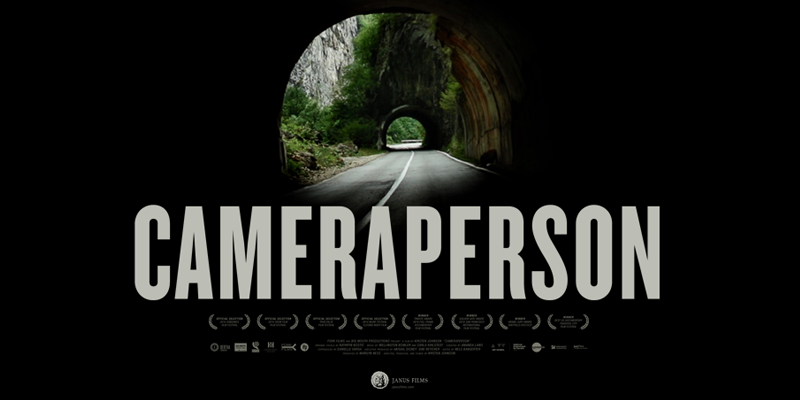
Cameraperson


Cameraperson is a memoir film from documentary cinematographer Kirsten Johnson. She took moments from throughout her 25 years behind the camera for other people's films and created this movie that summarizes her experience, using her visual perspective to talk about who she is and how she sees life. Rather than a linear storyline, the film organizes scenes around themes that express the range of joy and pain unique to her job and life. Just as a camerperson can choose exactly where to focus on an image to say something without words, Cameraperson uses a lifetime of filming to say something unique and beautiful without having to actually say anything at all.

Like so many of the best documentaries, this is a personal film. What makes this unique is that Johnson has these vignettes recorded from throughout her career where she is focusing on something outside of herself that when you pull together, using specific pieces, tell a lot about who she is. Johnson uses her own natural visual eye - always through her camera - to tell the story on its own without any direct narrative or description. She had originally created a more direct cut with voiceovers, focusing on the most traumatic and moving things she's captured. Eventually, though, Johnson and her team relied on the visuals to speak for themselves, using shots and scenes, juxtaposed in meaningful ways, to create a deeper meaning than you could ever really explain using words. More importantly is how the little bits they choose to use key into who she is without showing her at all.

Nels Bangerter, Editor for Cameraperson, was tasked with starting the process anew a few years into the project by taking several disk drives' worth of video and paring it down to tell a story. Rather than show some of the most objectively significant or traumatic things she'd shot, he focused specifically on the moments where we are aware of her presence, though rarely when we see her onscreen. Normally, a camerperson's directive is to go unnoticed, allowing the subject to be the focus rather than the person behind the camera. He said, "We began to realize that these tiny moments on the edges of other films is where her presence comes from...In essence we were making a very thoughtful, emotional, and revealing outtake reel." The mechanism by which this is done is often simple yet ingenious, like the short montage of many quick moments of Johnson walking with a camera, often backwards, and attempting to follow one or more subjects. Or a supercut of the moments where people realize they're being filmed. The observations are often weightier and become more personal as the movie progresses, her mother's experience with Alzheimer's and then eventual death playing a big role.

Using the visuals to tell the story leaves a bit more mystery in the film and allows us as the audience to arrive at conclusions on our own. At times Johnson uses the voices of her own subjects to comment on and share her feelings. For example, during a heart-wrenching scene in a Nigerian hospital we spend a few minutes watching a midwife work with a baby struggling to breathe. We then cut to an entirely separate sequence, distinct in date and time, of a man reflecting on having relived an intense moment of his past. He comments on how he can feel that emotion again so readily when he's not expecting it. While this is interesting, it becomes clear why we're watching it when we jump directly back to the hospital in Nigeria. Johnson is using his words to express how she feels watching and thinking about that baby and that hospital. And then, in the more meta context of Cameraperson, how these stories and experiences affect her life and stick with her. By showing us these principles, rather than telling us, we feel what she feels more readily just as we see what she sees through the camera. It's a brilliant way to communicate, even more so because when we as the audience make the realization on our own we may even jump to our own personal experiences and connect the idea directly to our own reality. And that's how storytelling like this can make an impact.

Friday, August 25, 2017

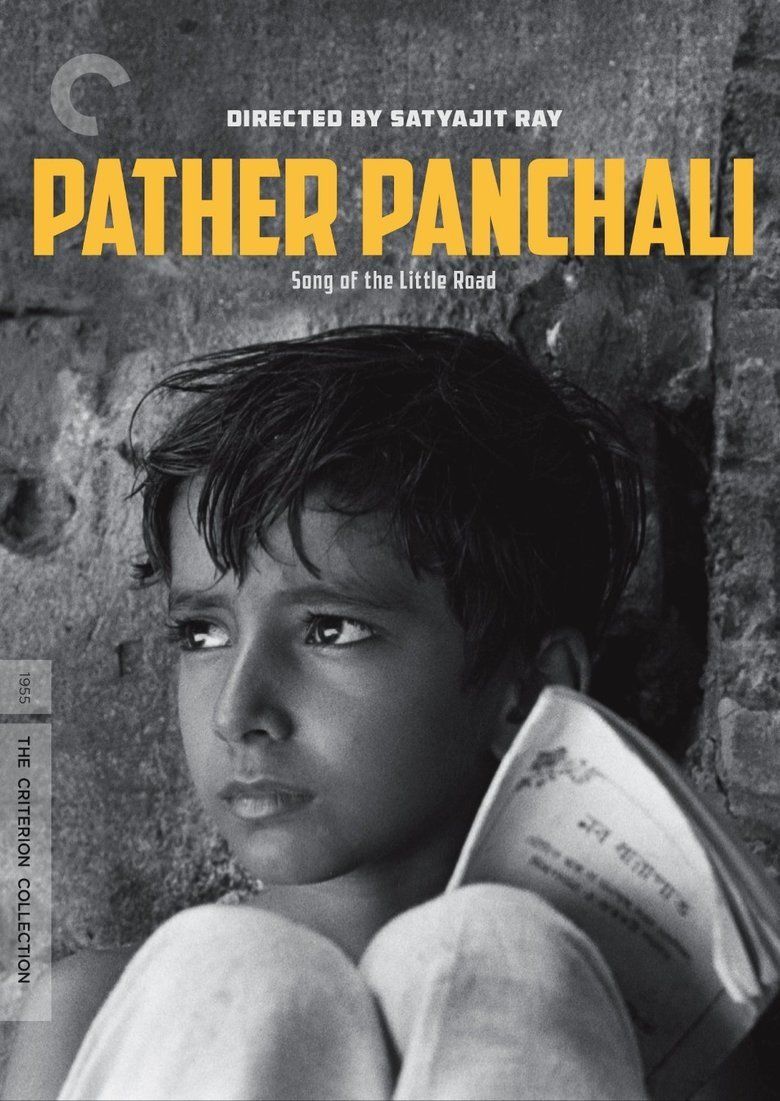
Pather Panchali

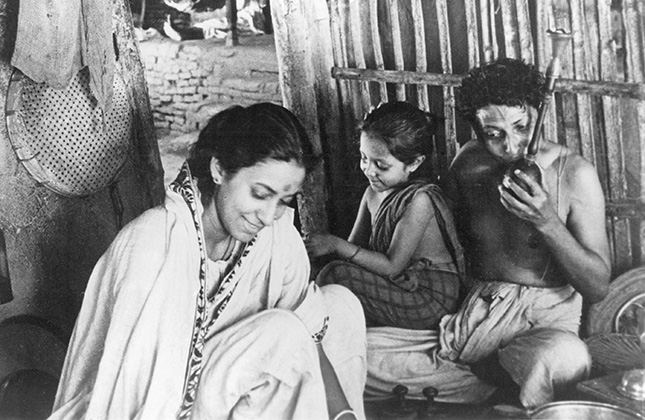
Pather Panchali, translated as song for the little road, is a simple, heartbreaking story of a poor Bengali family. Like most families, money is their biggest concern, although the mother and father seem to feel differently as to what degree. The mother is mostly left alone to care for her daughter, son, and an old aunt. She feels the pains of their poverty most potently as her husband, a self-declared poet whose ideas rarely come to fruition, is often gone for weeks at a time or more looking for work. Although this is the first in what became known as the Apu trilogy following the life of the young boy, in this film he is mostly observer of the women around him who struggle to live together. They clash in the natural ways that young girls often do with their mothers or a woman might with extended family living as not-so-welcome house guests. There are moments of relief along with some moments of terrible tragedy. These are problems faced regularly by families in almost any culture but here the consequences are, at times, more severe.


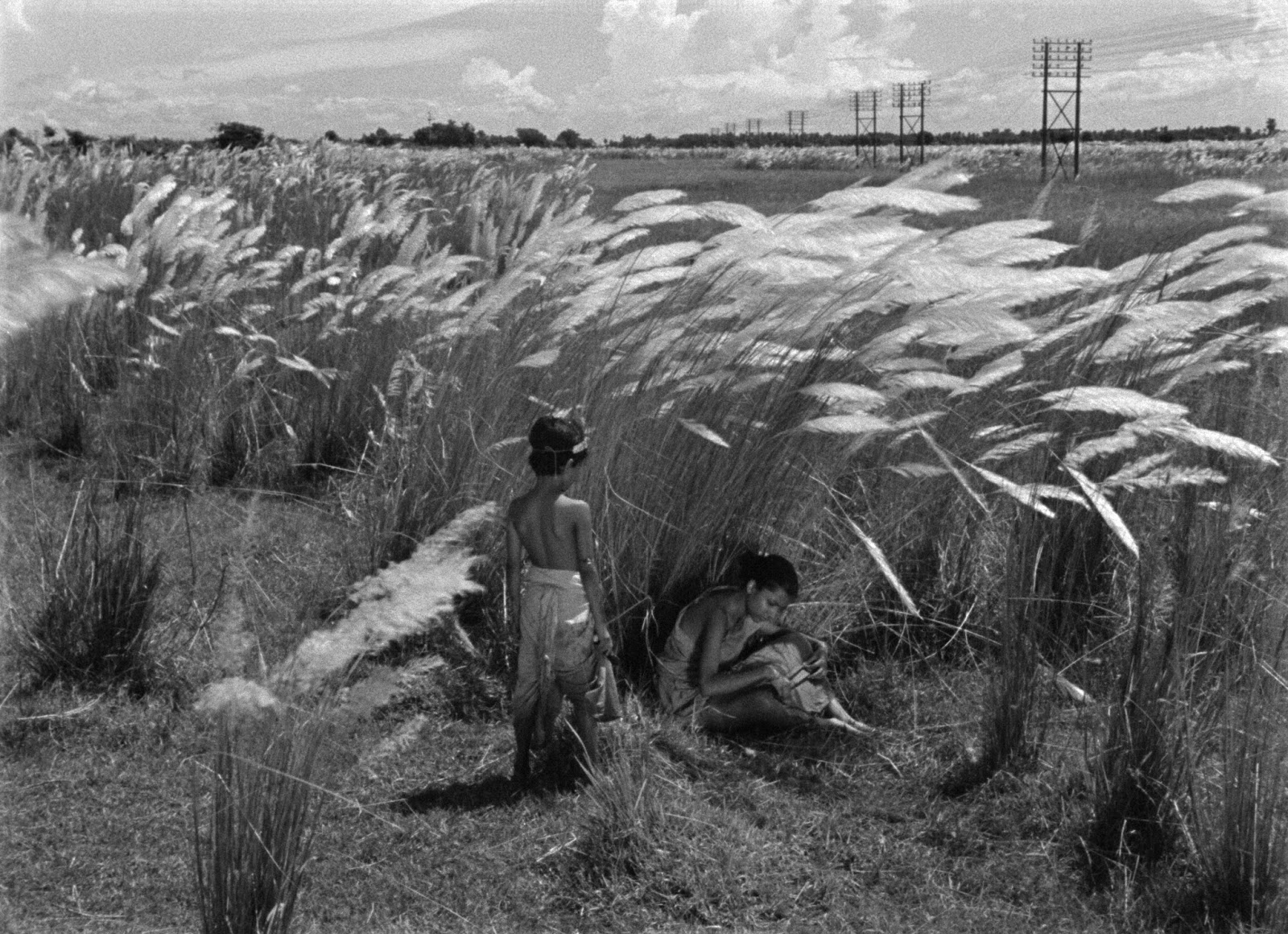
Along with displaying the reality of the relatable drama of life, director Satyajit Ray takes the time to explore and follow the digressions of life that always surround us, even amidst turmoil. Siblings argue constantly but just as easily reconcile and play. Neighbors and friends stop by and help but also add obstacles and make demands. The camera is especially descriptive as it focuses on small details, both mundane and divine. He's not afraid to sit and watch insects on the surface of the water or a pond of water lilies. Whether in the home or out in the jungle as children play, it's all very natural. The eye for beautiful frames is a great example of raw talent combined with beginner's luck and a clear purpose overcoming a complete lack of experience on the part of almost all the cast and crew. Although he's not as central to the drama, the bright-eyed boy Apu reminds us that children aren't fully aware of the extenuating circumstances that make up their lives and are always just themselves, finding it as easy to complain as to forgive.


It often happens that when you experience something personally groundbreaking that's contemporary to you, you imagine it's ideas are novel and innovative. Then, as you go through life you realize an earlier work did it first and better and your respect for that initial artifact diminishes in accomplishment, if not in its personal impact: "There is nothing new under the sun." An example of this is the Charlie Kaufman-written film Adaptation, directed by Spike Jonze. The movie is the story of itself. It follows its own screenwriter attempting to adapt a nonfiction memoir on orchid thieves for the big screen. As you watch you feel it is being written and produced before your eyes. Years later, in making my way through come of the cinema greats I would come to watch Fellini's masterpiece 8 1/2, a story of an acclaimed director attempting to come up with and produce his next feature only to end up creating a movie about the process itself. I learned Fellini did it first and best. This is all a meandering way to say that Ray's debut film Pather Panchali is the spiritual ancestor to Richard Linklater's longsuffering 2012 film Boyhood. Although I love that film, as with Fellini, Ray did it first and best.


This film, while not purposefully ambitious to the degree that Linklater's 12 year-long production was, it's struggles to get financing coming in starts and stops meant filming took place over three years. This meant big risks in relying on key cast members to be continually available, especially those so young and old as some of the key players here. More importantly than the logistics, though, Pather Panchali is similar in how sits in the life of a family. I laughed as the wife mentions home repairs that keep getting pushed back while the husband requests she look at life more positively even as he ignores the problems he's avoiding. The results of his procrastination have some devastating effects. But many of these scenes ring quite true to some that have played out in my own home. Undoubtedly some aspect of this movie will do the same for you.

Wednesday, August 9, 2017

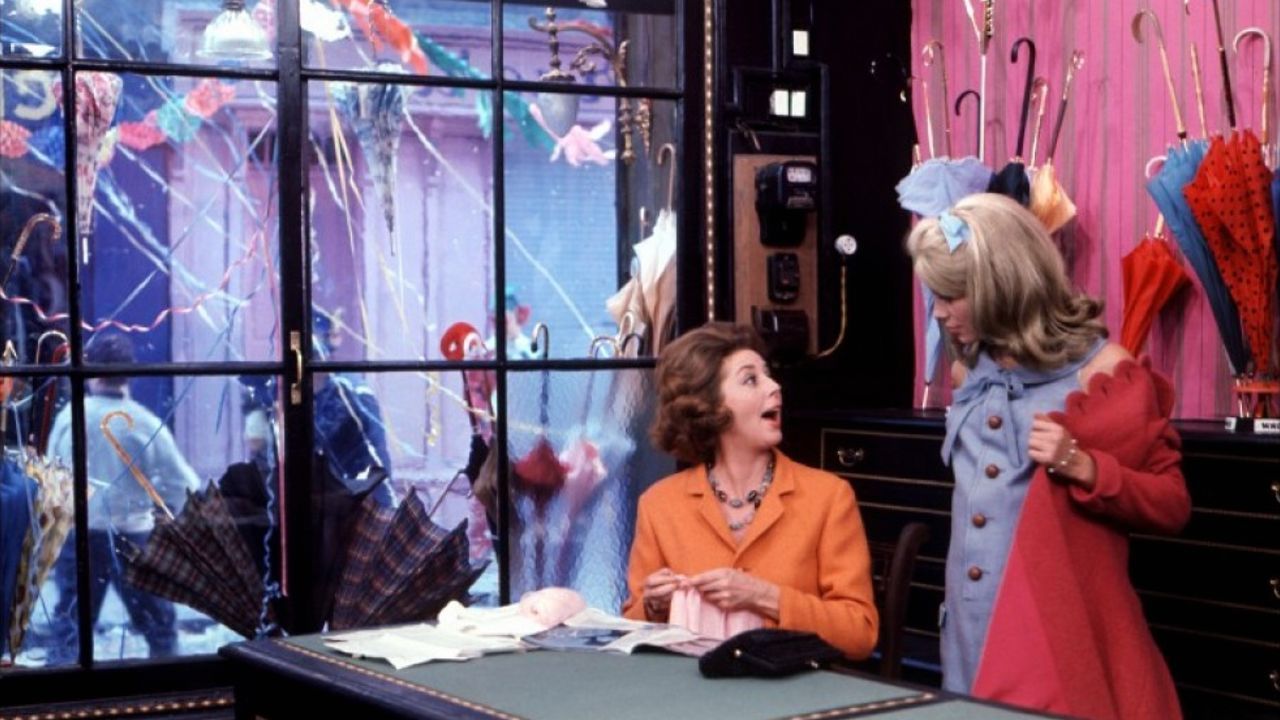
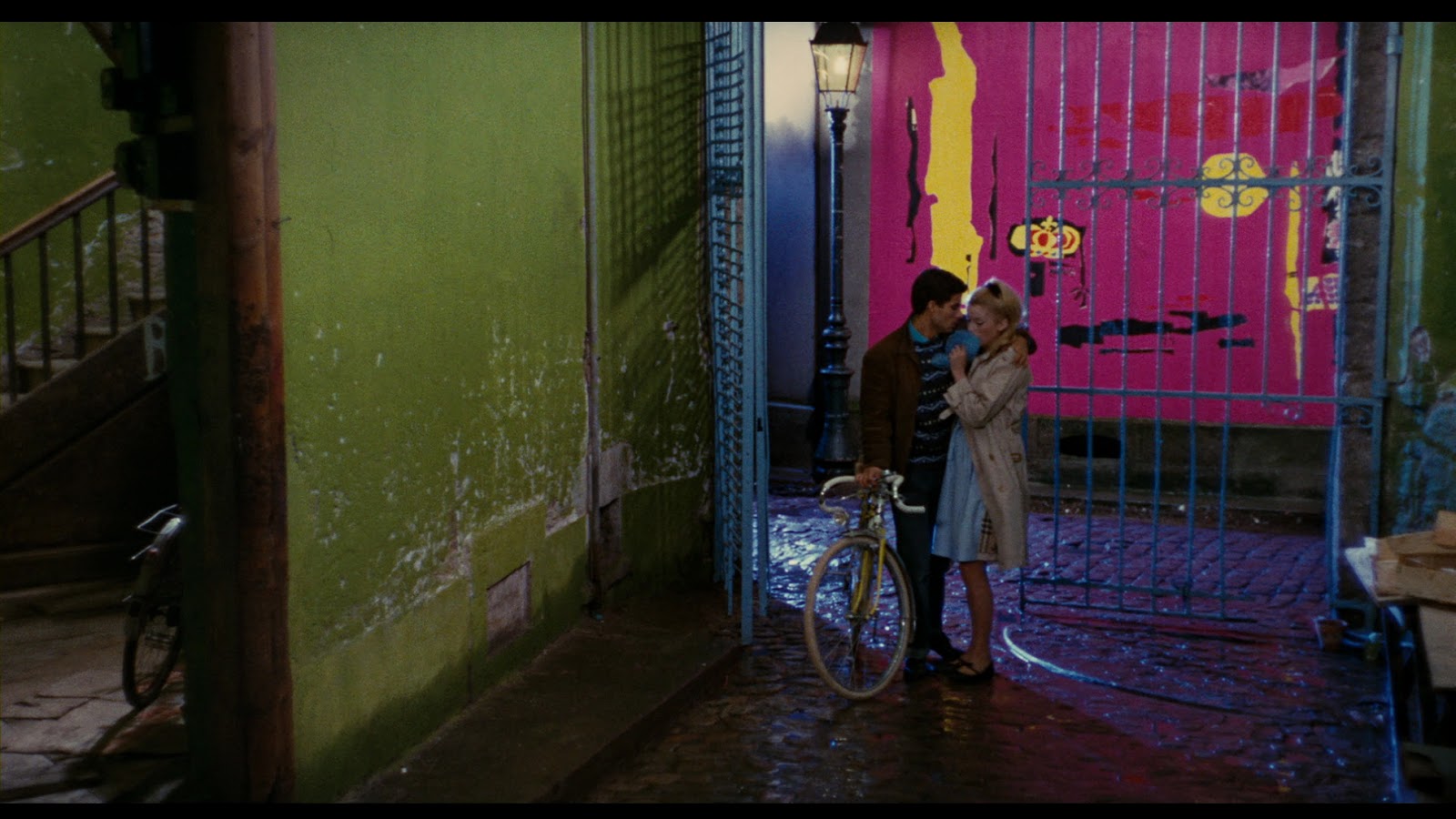
The language of The Umbrellas of Cherbourg

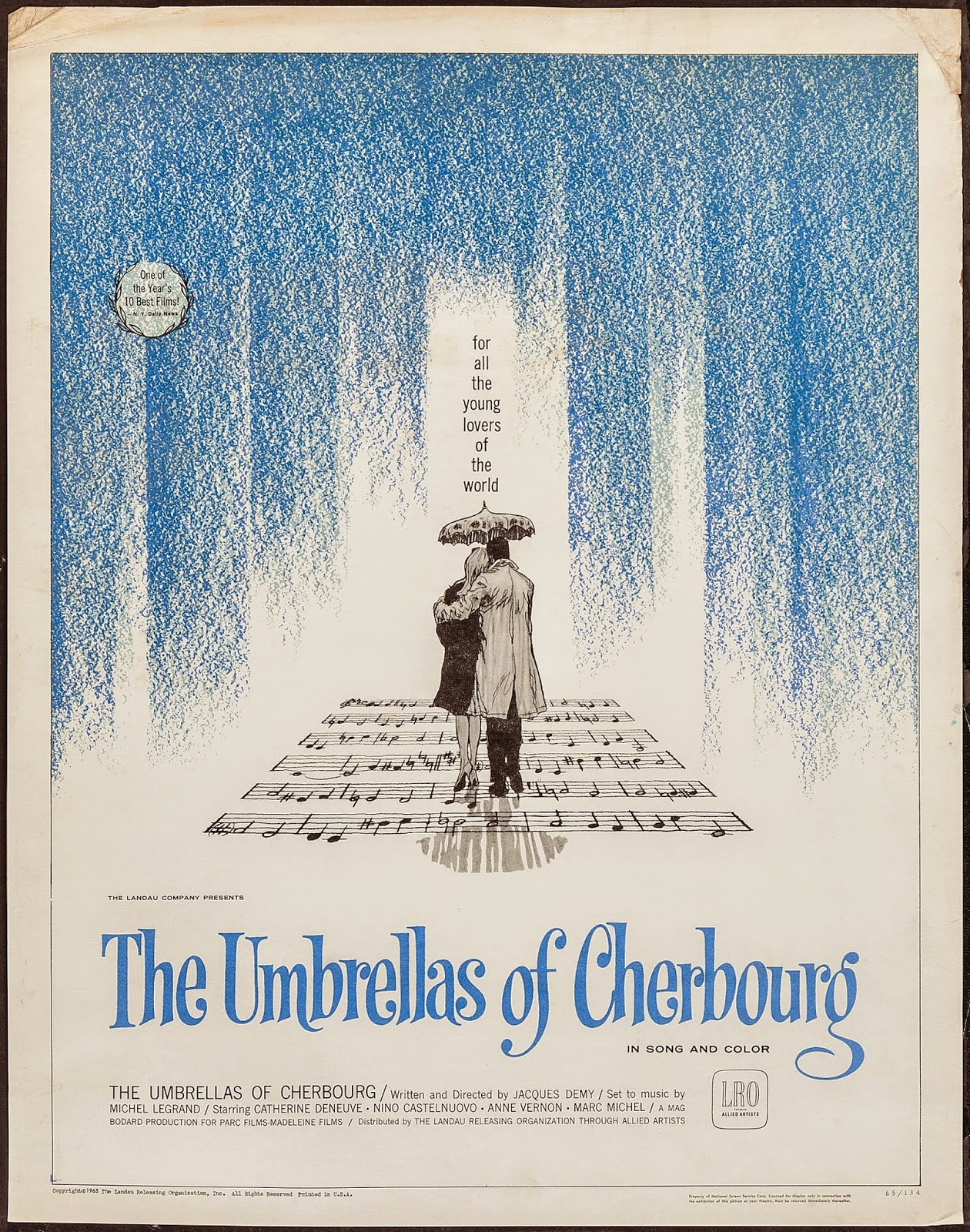
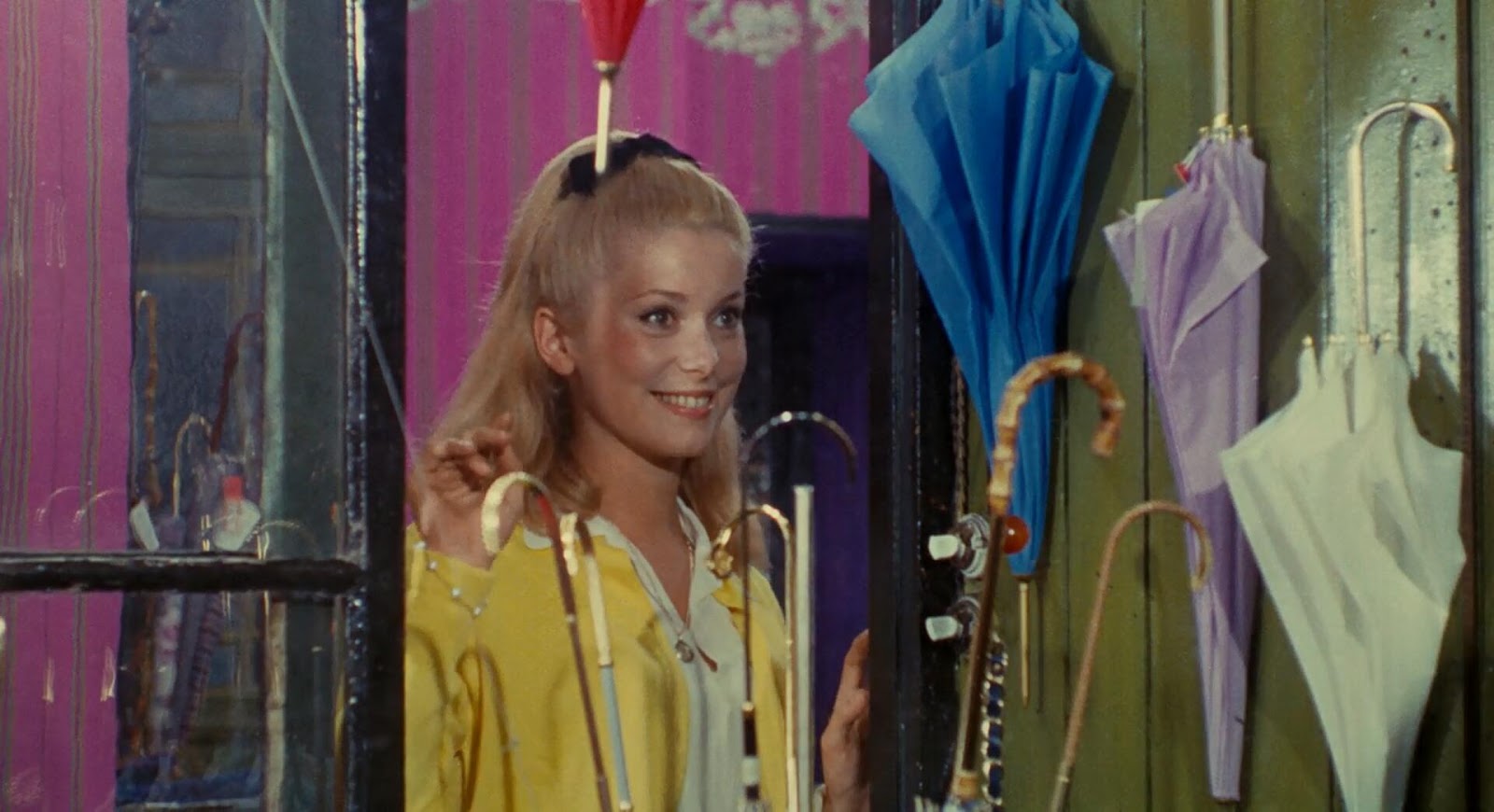
The Umbrellas of Cherbourg is a bittersweet tale of love, rich with 1950's & 1960's style and color. It is most recognized for its innovation: every line of dialogue is sung. While that is novel, and was certainly surprising in 1964 when it debuted, I think there's more behind its legacy. While so completely French, director Jacque Demy's vision is remembered and rewatched the world over. That's because it creates a new language melding film and music that transports the audience for a more direct emotionally moving experience.

One of the things about speaking in a new language is that you are released from your inhibitions. When I served as a missionary in Mexico for two years the first big challenge I had to overcome was, of course, speaking Spanish. I wasn't fluent and even after a solid two months of intensive language preparation, I still was only at a basic high school level. When I arrived in the country, however, I was paired with a native speaker that knew no English. And so with complete immersion (all I did all day was walk around and talk to people) I was soon dreaming in Spanish. That's when I found I began to speak more openly about emotions and feelings, both in what I shared and in what I asked about. It's a more direct, less complicated language and I had none of the social training that would've taught me to cringe at a curse word or shy away from direct expression.


Watching The Umbrellas of Cherbourg, a film where 100% of the lines are sung, was a similar language-learning experience. My impression of the singing style was awkward, at first. I don't know French so one issue is that I initially struggled trying to fit the English subtitles somewhere into the music. There's a learning curve that comes through the length of the film. What seemed strange at first and without melody, turned into a new dialect, of sorts, with an underlying bit of fantasy and a more direct emotional connection. As I succumbed to the constraints and rules of this mode of expression and stopped looking for the old musical language I knew, I began to really enjoy it.

The singing is sweet but the actors aren't virtuosos. There is none of the showboating of the big Hollywood musicals of the era. Demy reasoned that in traditional musicals you have starts and stops of the story with a cycle of exposition, dialogue, then song, then the story continues until it stops for another song, and so on. His goal was to create a musical atmosphere that flows continuously throughout the film's running time. While I still love the bombastic showtune-style of the greatest musicals like Singing In The Rain, Umbrellas uses music in a different way. It is the more direct influence of the recent hit La La Land, so if you liked that and want more or it didn't fully connect and you want to understand where it's coming from, watch this 50 year old predecessor that broke that ground first.


Umbrellas is fund of beautiful melodies and musical lines, but there is no delineation between separate songs. Instead it is one continuous musical experience. Demy and composer Michel LeGrand literally sat down at a piano with the screenplay and a blank sheet of music paper side by side and went through, page by page, adding notes to the written lines. In an interview, LeGrand admitted to struggling through the process. A key breakthrough came as a bit of inspiration when they translated the natural timbre of the spoken line for a scene, keeping the same rhythmic melody. That became the one truly memorable musical theme from the film, and the rest followed. The core meaning of the words and action are paired with the emotional message of the music. For me, the effect took root and started to swell as the story progressed. And yes, there is a story. It's about young love, loss, and the path that life leads. It's almost a "tale as old as time."

Thursday, February 23, 2017

Oscars Week: Manchester By The Sea

The reality is that death comes and we should all be expecting it. Except that it happens so rarely and so we become so far-removed from it. That's not true for everyone across the world, of course, and for Lee Chandler (played by Casey Affleck in an Oscar-nominated performance) it may seem to happen a bit more often. In Manchester By The Sea we watch this character face not only the death of his brother, resulting in his inheriting guardianship of his 17 year old nephew, but also a more intimate tragedy from years before. It is this earlier horror that really hangs over everything happening in the real-time of the film and which underlines Lee's grief. The film uses these situations to really examine the reality of death from the perspective of those left living.

And that's what Manchester By The Sea does so well. It takes a look at those moments around the death of loved ones that, when you imagine them happening to yourself, make you say, "I don't know what I'd do." This film sits in those periods of time seconds, hours, days, weeks, months, and years after the unimaginable happens. It's not a film with emotional grandstanding or heavy on the tears. Instead it is like a real-life guide of what to do when someone close to you dies. There's a list of things to take care of and Lee is too busy getting to the business of hospital paperwork, wills, and funeral arrangements to face the fact that a person that was there is now gone.

Because, at least according to this film, there are a lot of logistics and worldly affairs to take care of right after someone dies. Sure, we all know this, but who really knows the right thing to do in those moments? How do you negotiate funeral prices and make life choices with long-term impact in a state of arrested grief? Well those that have been through it know what they did and Manchester By The Sea seems to have been crafted by someone who has been through that and knows those struggles.

Kenneth Lonergan, who wrote and directed the picture, relieves the audience from having to face the overdone, melodramatic, and tedious scenes you expect but that, thankfully, never actually come. Don't get me wrong, there are some heart-wrenching scenes in this film. A lot of pain is communicated, but there's growth and understanding as well. Lee Chandler was a loving and happy husband and father before he went through what he did and the frustration of dealing with tragedy takes its toll, always bubbling below the calm yet hostile surface and manifesting itself with random angry punches.

Lucas Hedges plays Patrick, the surviving son of Lee's brother Jon, and received an Oscar nomination for the role. He delivers a take on how a millenial teenager might react to what is a not wholly unexpected death - his dad was known to have congenital heart disease and had been in the hospital several times before. I wondered if it was unrealistic how easily he seems to take the news and keep a sense of humor, but in time you see what he goes through.

The uncle-nephew relationship takes center stage as it explores a situation where there's love but also struggle. Kyle Chandler plays the father and has plenty of screen time in flashbacks which come and go quite easily to the point that they don't really feel like flashbacks at all. My one regret for this movie is that while Chandler does get dialogue, he's a bit more of an ancillary presence. Maybe that's because I remember him affectionately as Coach Eric Taylor from Friday Night Lights and here he plays a sort of version of that character with his matter-of-fact, let's-get-moving approach to adversity.

Rounding out the cast is a lovely Michelle Williams performance and I certainly wouldn't have minded to see more of her character's journey and relationship with Lee. A touching random encounter on the street near the end of the film underlines what Lee hasn't yet fully faced and why his improving relationship with his nephew Patrick benefits from mutual understanding. Death is a permanent part of life and it can't be forgotten.

Manchester By The Sea is currently available for rent or purchase through iTunes & Amazon.

Friday, January 6, 2017

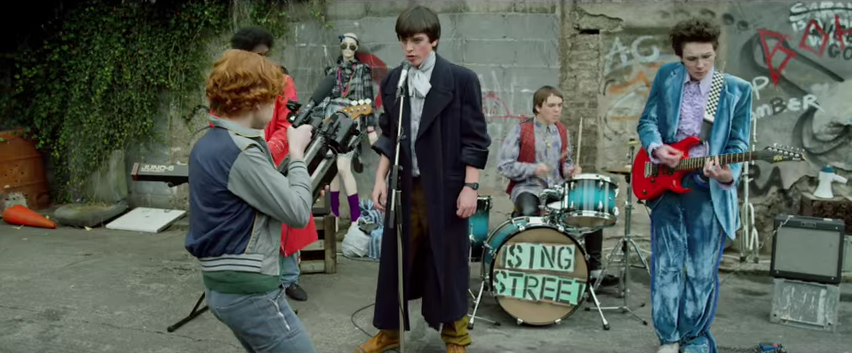
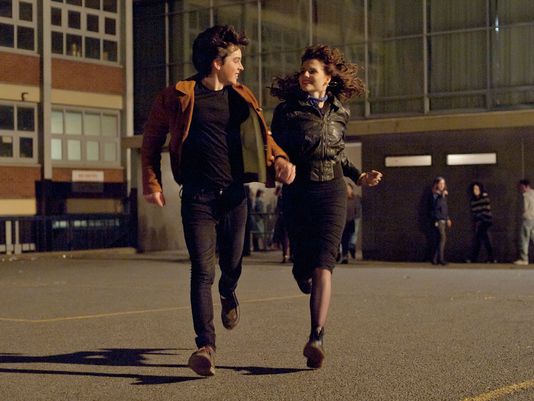
Sing Street

John Carney drew a lot of attention when his small, very low-budget film Once made a splash at Sundance several years ago. It shot him to prominence, at least in the indie-film world and lead to his first bigger-budget movie, Begin Again, which brought with it some star power in Keira Knightly, Mark Ruffalo, and Adam Levine. Now in his third outing, Carney gets even better with the warm and fun film Sing Street. If you've ever wanted to bottle-up the essence of positive youthful possibility and fearlessness, mixed with mid-1980's music culture, then look no further.

Carney has made himself the resident expert of a certain subgenre of musical film using the possibility of music as a career to therapeutically tackle and trascend whatever difficult situations life throws at you. Music is sound-in-motion, and paired with the medium of film--or pictures-in-motion--has been an exciting combination since it was first conceived. Music videos, while becoming a distinct short-form art medium delivering pop culture at scale through MTV in the 80's, have always been a part of film since sound was incorporated in some way. While silent film had a different soundtrack every time it played depending on who your house organist was, that flexibility allowed it to be always changing. The moment sound was added to movies music came right along (The Jazz Singer, 1927). In fact, one of the most timeless movies of all time, Singin In The Rain, is about the story of sound and music in film. While true musicals are few and far between nowadays (La La Land just stole our hearts) music in film as both a storytelling tool and as a narrative subject has never been better.

Sing Street takes this to the limit with it's surprisingly moving storyline about a young man and woman in Ireland in the 80's. The economic crisis there is dire and families are suffering. Conor Lawlor, our protagonist, is forced to attend a lower-class school as his parents work through marital and financial troubles. What I love most about Conor is that even as a generally introverted character, he has bravado in the moments that count and through that he becomes an unexpected leader. When he sees a pretty girl on the stoop across from his new school he builds the courage to talk to her and then, in a moment of desperation, he lies that he has a band and that she'd be good in their new video. As he walks away after having successfully gotten her number he hastily whispers to his friend, "We need to form a band." He's good at making it up as he goes along in the fake it till you make it category.


The core of Conor's journey in the film is his relationships with the girl, Raphina, and his brother. In both of them he sees a level of experience and worldliness that he seeks after while both learn unexpected lessons from his less-cynical and free spirit. The relationship with his older brother, Brendan, is one of the sweetest and most encouraging parts of the movie. How Brendan chooses to assist Conor in freeing himself from the confines of their complicated home life is one of the greatly nuanced and mature aspects of the story. He helps Connor see his parents from a more adult point-of-view that both helps him appreciate their struggles and recognize their flaws. Brendan also tells him step by step what he needs to do if he's going to be successful in using music to get girls. He asks, "You want to have actual sexual intercourse, right?" Connor is confused, "Yeah. Wait, what?". "The girl, it's all about the girl, isn't it?" Brendan asks. Conor obviously hadn't quite fully considered his more innocent intentions. This is a pretty basic part of the older brother job description (and probably why I never had any luck in that area in high school, not having any brothers).

One of the continual joys of the film is the many ways creativity and song-writing become the choice Connor uses to deal with a situation. Whether he's anxious to impress a girl, angry at all the oppressive forces at school, stressed about his family situation, deliriously happy, or working through any other number of things, he uses music as a positive tool to process what he's feeling. And we benefit. Songwriting team Carney and Gary Clark channel the 80's feel but with a modern sensitivity that makes the original songs instantly lovable. After watching Sing Street I went right out and bought the soundtrack. While it includes several of the genuine 80's songs used throughout the movie from groups like Duran Duran and Motorhead, I skip over those and go straight for the originals. Carney prioritized casting actual musicians so the group of kids are more genuine in their performances. They sound great.


Within the film, the songwriting scenes are some of the most enjoyable to watch. There's the typical "get the band together" sequence where Conor and his new friend Mark round up all the musicians they know to create a ragtag group. Mark is the resident "real" musician and seems to know how to play every instrument under the sun. He becomes Conor's song-writing partner. By the end of the film you get excited every time Conor shows up at Mark's door to write a song. In a similar fashion to the scene in Begin Again where Mark Ruffalo's character envisions a full band accompanying Keira Knightley's solo acoustic performance, we'll see a time lapse of the writing of a song as you hear it with new band members joining in at key points as it develops. And combining Carney's own loves for both film and music, the music video sequences are especially joyful and hilariously cheesy.

While I've heard others disparage the ending of Sing Street, I don't know what they see. Without giving it away, the very final scenes, accompanied by a great song sung by Adam Levine (and co-written by Levin, Carney, and Once's Glen Hansard), it captures symbolically the hope and uncertainty of youth and someone determined to give his dream a chance when the odds are slim. It is the emotional climax, well-earned from the depth of relationships and struggle that Conor experiences throughout the film's story centered on both romantic and brotherly love.

Streaming now on Netflix


Tuesday, November 1, 2016

Eye In The Sky

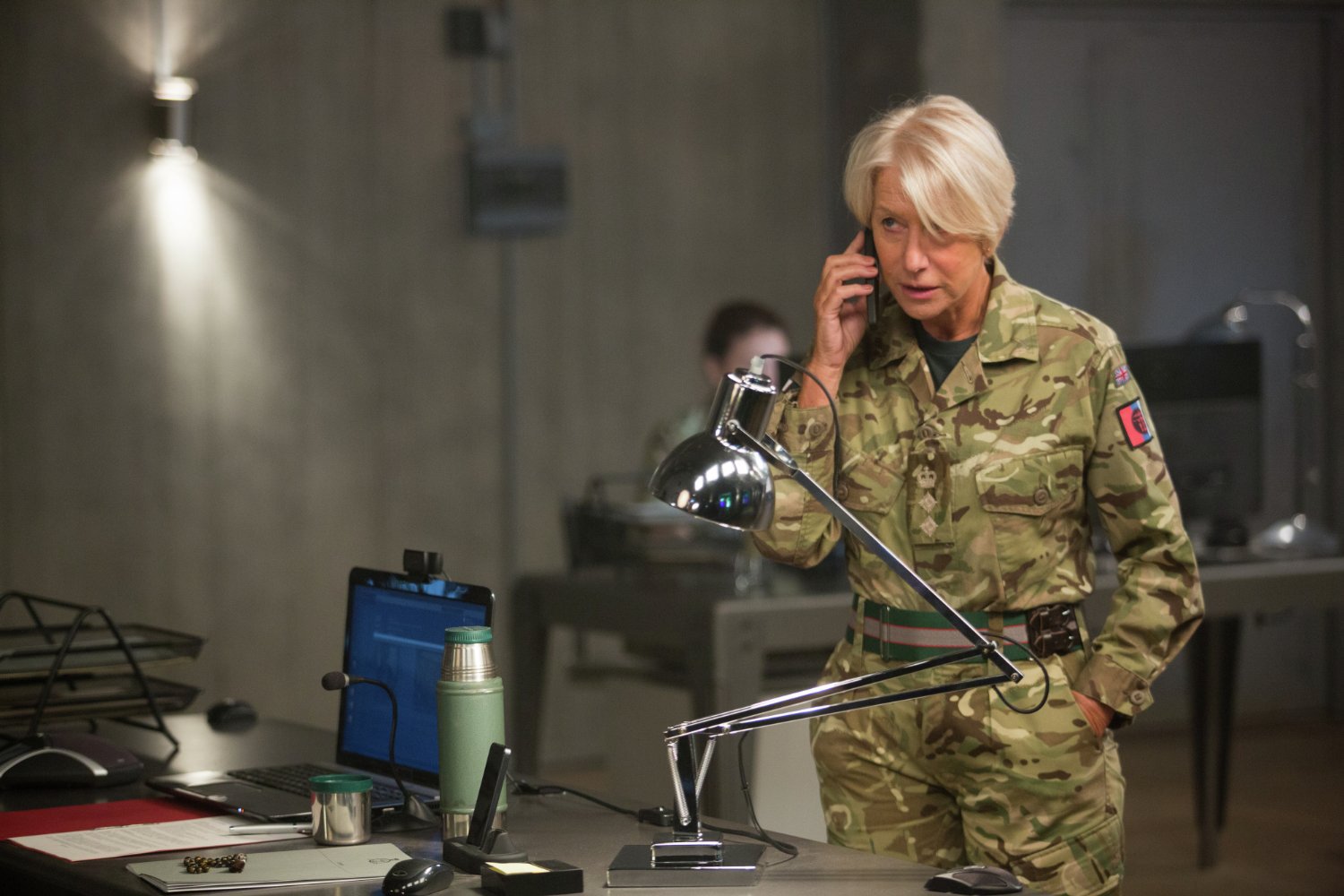
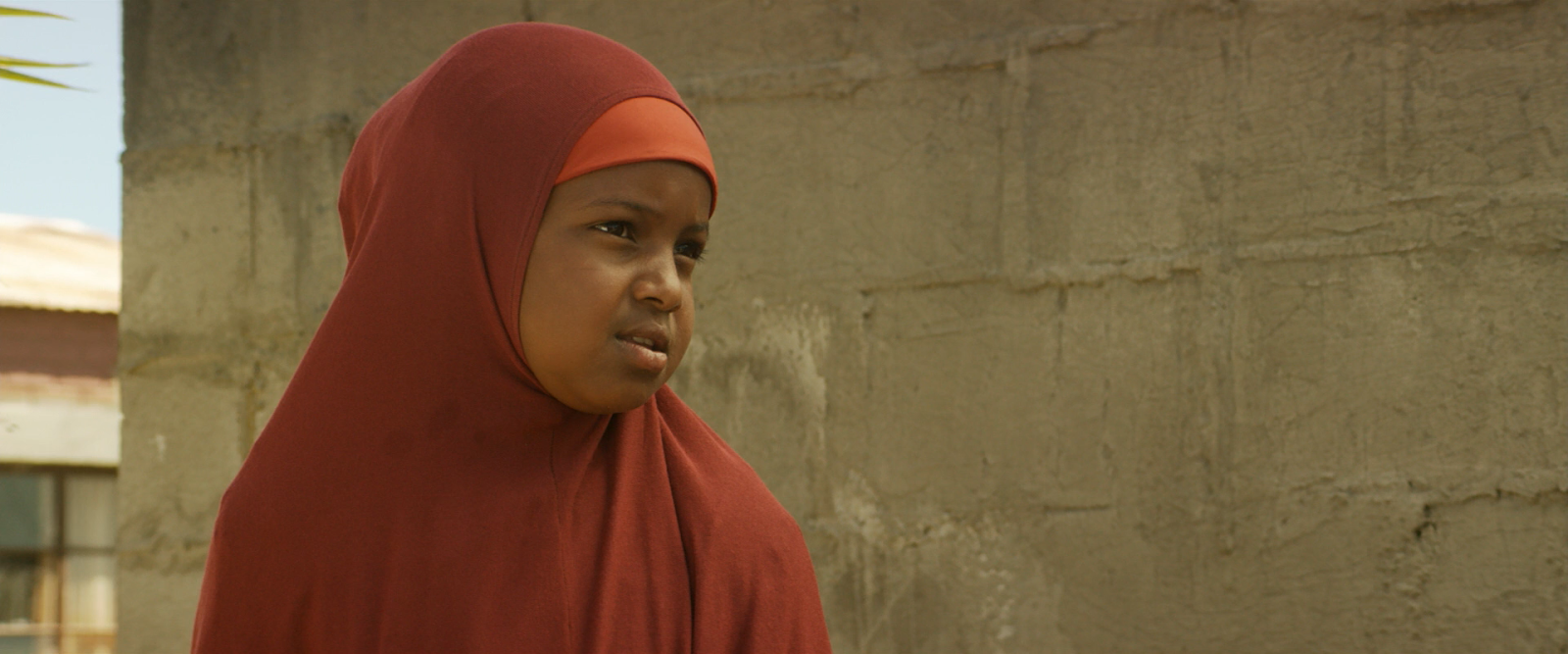
A modern take on the 12 Angry Men concept but as a thriller, Eye In The Sky is a riveting exploration of group-think and morality in an era of depersonalized warfare where bureaucratic procedure and legal safeguards reveal there's still always someone that has to pull the trigger. Helen Mirren plays an English Colonel presented with an opportunity to take out several high profile most-wanted terrorists in East Africa. Her team consists of a joint task-force represented globally and coordinated through multiple forms of conference communication. Soldiers, technicians, and politicians are all connected via satellite from locations in England (Surrey & London), the US (Las Vegas, Hawaii, DC), Kenya, Singapore, China, etc. What starts out as a more simple mission of capturing a few terrorists based on solid intel becomes a more complicated decision of deploying a destructive payload from an unmanned aircraft towards multiple targets. The complication comes from one little girl selling bread in the street. Do they risk killing her or allow the potential killing of dozens from suicide bombers?

Overall I found Eye In The Sky to be a well-constructed demonstration of the choices facing those in power. Despite the shortcuts and possible fudging of numbers or of laws, I was impressed at the level of deliberation and thoughtfulness that went into a difficult decision like this. The situation is fraught with potential political, moral, and ultimately human consequences. The film does a great job of remaining an observer of the many viewpoints expressed for or against pulling the trigger and the subsequent collateral damage - one of many terms used as placeholder for the more terrible-sounding truth: possibly killing an innocent girl. There are no good choices.


The choices that must be made here by politicians and cabinet appointees are uniquely modern due to the progress of technology. The decision that would have been made by a soldier or officer in the field decades before is now being presented to, essentially, a committee. The existence of an omniscient eye guided by pilots half a world away allows real-time observation and analysis. The Kenyan intelligence team on the ground is just another resource available to Mirren's character and her team, always calculating percentages and probabilities that really represent actual human lives.


I was even more surprised to realize when the movie ended that Gavin Hood was the director (he also has a small part). After doing an A-for-effort job in directing the ultimately disappointing adaptation of Ender's Game I wouldn't have given him the credit of assuming he could deliver a film with such balance within ambiguity in Eye In The Sky, but I'm not as familiar with the rest of filmography.


The cast was convincing in presenting the many different points of view, most of them valid from one perspective or another. While Helen Mirren, Aaron Paul, and Barkhad Abdi (Captain Phillips) all do an excellent job, I noticed Alan Rickman most especially considering this was his final film role. They all have their part in this international coalition. Some characters see the choice before them as simple. Are they brave or foolhardy? Others see it as more difficult to make and are unsure. Are they morally cautious or cowardly? The film provides an excellent exploration of these questions and the result could be interpreted easily as making the case for any of the different viewpoints - and that is reflection of great skill in writing and directing.